Wednesday, October 2, 2013

Additional Language Resources For The Everyday Analyst

Ethnologue is one of additional language resources mentioned in this article

To conclude the three-part Linguistics blog saga, preceded by the Top 11 Online Language Learning Resources and the Top 10 Online Translation Services, here are a few excellent language resources for the intelligence analyst!
  • Linguist or not, this one is important! The Ethnologue is the international authority on living languages, maintained by SIL International, a Christian linguistics group that originally founded the site in 1951 to translate bibles into local (and lesser-known) languages. Oh, how the site has grown since then! Search by language, search by region or search by country and you will find the full linguistic breakdown of almost any geographic area.
  • Note: If you're interested in language mapping, World GeoDatasets provides the World Language Mapping System, the most current and up to date maps and GIS information on international language distribution. It is a collaboration between Global Mapping International and Ethnologue, but be warned, it is not cheap! 
  • The World Atlas of Language Structures (WALS) is a comprehensive collection of linguistic sources searchable by language (every language you could possibly think of) or by language feature. You can search for Arabic, for example, (but which one? - this site lists 21 different dialects!) or something a bit more interesting, like Achuar or Waropen (they exist, I promise, and they aren't the strangest languages on this website). You could also search for language features like Subject-Verb-Object (SVO) word order, for example, or optional double negation. Either way, your search output will be a comprehensive list of scholarly sources written and published about the language you select.
  • Omniglot is my third favorite online language resource. It is an encyclopedia of writing systems and languages. For many different languages (yes, all the strange languages you just encountered in the WALS, plus Tengwar (!), J. R. R. Tolkien's Elvish language), it provides the alphabet and the International Phonetic Alphabet (IPA) symbols. In addition to phonetic and transcription information, Omniglot provides a list of links that pertain to information about the language such as resources for learning the language and/or the writing system it employs. 
  •  Voice of America's Pronunciation Guide is ideal if you are trying to learn how to pronounce foreign names and places correctly.  It won't help much with words but if you want to meet the standard for intelligence briefings, you have to know how to say the places and people correctly and the VOA takes away your last excuse.

Monday, September 30, 2013

Top 10 Free Online Translation Services

Ed. Note:  Since last week's language learning resource blog post was so well-received, consider this a second linguistically-inspired and - hopefully - equally well-received post (of which, I have no doubt, there will be many more). 

The reality of the situation is that this is what the world looks like. We live in an increasingly multilingual society and, as analysts, this inarguably affects our jobs. Daily. 


Figure 1: Languages of the World - Source: This wonderful data visualization
So in light of this increasingly multilingual operating environment, how do we make our jobs easier? 

Below is the answer (an answer, at least) to this question: A compendium of (free!) online machine translation services rank ordered by way of a little linguistics experiment!


Top 10 Online Translation Services
(rank ordered by number of languages translated and evaluated on a five point scale in terms of error rate - 5/5 is best)

1. Google Translate. 3/5
  • I would be remiss in this post if I did not include the infamous Google Translate (for all the flack it gets, I really don't think they are too horrible). And besides, where else do you plan to translate from Azerbaijani to English? With 72 languages, they have the largest repository of the online translation services, but... then again, it's Google.
2. Dictionary.com Translator. 3/5
  • The Dictionary.com translator is a close second with 53 translation languages, Icelandic and Maltese among them. The only downside is that there is a 300 character limit to translation so, if you're planning on dumping paragraphs into the translator (which you really shouldn't do anyway), this one is probably not for you. 
3. Bing3/5
  • The Bing translator maintains a 44 language repository with a user interface (UI) as appealing as Google's, and the recent buzzing in the blogosphere gives Bing the edge over Google when it comes to translation services. 
4. Free Translation. 3/5
  • Free Translation (using SDL translation services) translates from 41 languages (Bengali among them!), but only into the big five (English, Spanish, Italian, French and Portugese).
5. BabelXl. 3/5
  • Babelxl translates 36 languages.
6. itranslate4.eu.
  • This one is my personal favorite! As an avid linguist and frequent translator, I consider itranslate4.eu to be the most exciting find of the day. This site translates both in and out of 35 languages across many different search engines! Your output is the same translation provided by SYSTRAN, linguatec, PROMPT and others. This allows you to compare translations for greater comprehension and accuracy. Also, the language repository includes unexpected languages such as Breton (go ahead ... look it up), EsperantoKazakh and Occitan.
7. Babylon. 3/5
8. SYSTRANet. 0/5
  • A little history: SYSTRAN is one of the oldest machine translation software (dating back to 1968) and, what do you know, they now have an online translator SYSTRANet. It translates out of 15 languages but only into the big 5. Google used SYSTRAN until circa 2007 and it is the current translation software behind the dashboard translator app for Mac OS X. 
9. Babelfish. 4/5
  • Babelfish (not to be confused with Yahoo! Babel Fish, which is now the Bing translator) translates 14 languages both ways. Again, the 300 character limit applies.
10. Reverso. 2/5
  • Reverso is an interesting site. It makes up for a clunky UI and limited language capacity (9 languages) with the option to have your full translation read to you in the target language simply by clicking a button. 
A Linguistics Experiment

Just in case you were wondering, I didn't arbitrarily invent the number out of five (after all, who am I to judge; as I said before, I use Google Translate...)

In order to evaluate the 10 translation services listed above, I took a snippet from an article written in Spanish and plugged it in to all 10 translation engines. Below are the resulting ratings out of five calculated by subtracting the number of errors from five.

This was a simple example and should in no way preclude you from trying all of these translation services at some point to determine your personal favorites, but based on this experiment, Babelfish returned the best translation.
This is what was translated into English: "Lingüistas de la Universidad de Glasgow han demostrado de que ver la televisión de manera activa puede cambiar rápidamente un determinado acento. Tal y como publican en la revista especializada Language, sus conclusiones se basan en el análisis de los efectos de la telenovela británica EastEnders, emitida por la cadena británica BBC, sobre el modo de hablar de los escoceses."
Common errors included:
  • Failing to translate the infinitive Spanish verb "ver" into the gerund English equivalent watching (as opposed to watch). 
  • Incorrect syntactical word order of adverbs in the first sentence such as actively ("de manera activa") and quickly ("rapidamente"). 
  • No service except for Google Translate managed to successfully translate "revista especializada" to journal as opposed to specialized magazine.
  • Mistranslation of the past participle "emitida" to various other English connotations such as emitted or issued.
  • No service successfully translated the final clause "sobre el modo de hablar de los escoceces," which means "about the Scottish way of speaking" or, more colloquially, "about the Scottish accent." Common translations were: "the way to speak of the Scotts," "the way of speaking about the Scotts," and "how to talk about the Scotts." This is because in this clause, "de" can be interpreted to mean either "of" (correct) or "about" (incorrect); so this error was due to a mistranslation of the preposition.
**Note: Most U.S.-based translation services translate English-Spanish better than other languages because that is the language combination historically in the most demand within the United States. In short, the more obscure the language, the less accurate the translation. This translation experiment is probably a best case scenario.

For those interested in reading the article from which the sample text came, it is from the Muy Interesante (the New Science Magazine of Latin America) titled Ver la television puede cambiar tu acento! (Watching TV Can Change Your Accent). 

Don't speak Spanish? Use one of your new-found translation services!

Know of a trusted translation service not listed here? Leave a comment!

And finally, to conclude this linguistics saga of blog posts, check back on Wednesday for a post containing other language-related resources particularly relevant to analysis!

Thursday, September 19, 2013

Top 11 Online Language Learning Resources (Or: How To Make Yourself More Attractive For US Government Intelligence Positions)

In fiscal year 2011, the National Intelligence Program (NIP) made payments to 7,507 government employees within the CIA, DIA, FBI, NGA and NSA for foreign language proficiency (See the Washington Post's breakdown of the so-called "Black Budget"). This is not surprising given the Director of National Intelligence's emphasis on foreign language capability within the US national security intelligence community.

Among the top foreign languages are all the usual suspects - Spanish, Arabic, and Chinese -whereas less common languages populate the "special interest languages" list - Tagalog, Punjabi, Somali and Urdu. 
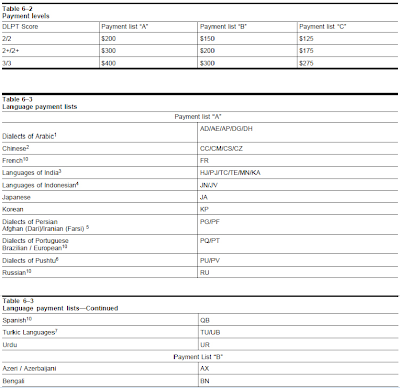
Figure 1: Snippet of the US Army's Language Payment Incentives

Similarly, the scores on the Department of Defense's DLPTs (Defense Language Proficiency Tests) can earn you pay incentives within government positions and the US Army for each of three language lists - A, B and C - ranked by importance (See Figure 1).

What does this mean for entry-level intelligence analysts? 

It means that being bi- or multi-lingual is practically a pre-requisite for an intelligence analyst position.

Can't afford Rosetta Stone or other expensive programs? No time in a busy class schedule (or even busier work schedule) for a foreign language course?

Don't worry - You don't have to have a BA in Balkan Studies to pass a Serbo-Croatian language exam. There are plenty of (free!) online resources to help you achieve language proficiency levels all on your own. 

Below are the top language learning resources on the web according to the blogosphere:
  • DuoLingo. The absolute best thing about DuoLingo is that it is free! The only downside is that it currently only offers instruction in six languages, all of them European (and four of them romance languages). Of the free resources, DuoLingo's classes are arguably the most structured (and they also have an app!)
  • LiveMocha. A DuoLingo rival is LiveMocha. Though the premium version is not free, the unpaid offering is significantly more robust than a standard trial version (and with 35 languages, their selection trumps that of DuoLingo). An alternative to paying for the premium upgrade is engaging in the LiveMocha social network and tutoring or offering rudimentary language instruction as a native speaker of your mother tongue in exchange for credit, which can then be applied to your language program of choice.
  • OpenCulture, the cultural education blog, features a compendium of resources for language learning in 46 languages. The first suggestion in the majority of the language lists points you towards free iTunes podcasts and downloads for language learning, largely posted by the Radio Lingua Network (entitled Coffee Break) and The Peace Corps. (Also, see OpenCulture's full list of free online courses from top universities).
  • Busuu. Busuu is of the same ilk as LiveMocha - It is interactive with a robust social media component, but also provides limited content with expanded content provided for premium members. LiveMocha, however, provides many more languages than Busuu's limited 12 language offering. Despite these limitations, it remains one of the more highly ranked language learning resources on the Internet. 
  • The US Department of State is also a good place to find language learning resources, though the Foreign Service Institute is likely for the more linguistically-inclined. The FSI posts all its language materials for 45 different languages online in an open source format including student text to audio recordings. Though the content is not aesthetically appealing and no instruction is provided, the resources are professionally-developed and highly useful, especially for those already fluent in the Linguistics vernacular.
  • The Defense Language Institute/Foreign Language Center (DLI/FLC).  DLI is one of the very best language schools in the world.  In addition, it also provides a huge amount of its material for free.  Need a language survival guide in Bulgarian?  Try DLI.  Need a quick series of lesson in Afghan handwriting?  Try DLI. Need to know how to say "Goodbye!" in Balochi?  You guessed it - DLI.  There is a just an immense amount here and in a variety of hard-to-find foreign languages.
  • Lang-8. Lang-8 is an interesting resource that provides a network of native speakers to correct foreign language writing submissions. It's pretty simple - You correct the submissions of others in your native language, and submit your writing to be corrected by others. Lang-8 boasts a network of native speakers from 180 different countries.
  • RhinoSpike. RhinoSpike is a network similar to that of Lang-8 that facilitates the exchange of audio files alongside the text documents.
So now that you've got a collection of language learning resources on the Internet, there are a handful of what can only be considered recreational practice resources also available:
  • iSketch. iSketch is my personal favorite.  I used to play this all the time when I was learning Spanish! It is essentially an online form of Pictionary that can be played in English, French, Spanish and Portuguese with variations in languages such as Turkish and Swedish. It is easy, informal, extremely entertaining and useful for practicing foreign language vocabulary.
  • italki. italki is an online community of Skype users aimed at language learning. Pay for individual Skype lessons, or arrange Skype lessons in your target language in exchange for giving lessons in your native language.
  • Verbling. Verbling operates around much the same concept as italki, but is a bit more structured. You can sign up for an attend group lessons (the schedule for which is broadcasted on the home page) or you can pay for private tutoring sessions (the going rate is typically $25/hr).
When it comes to language, nothing teaches better than in-person interaction. My recommendation is to pick up the basics of whatever language you seek to learn from list one, then do the majority of your language learning on list two connecting with and talking to native speakers of your target language.

My final caveat to this resource repository is that nothing (I mean, nothing) compares to a passport when it comes to learning a foreign language. Though a round trip ticket to Argentina is a lot more expensive than the one-time purchase of Rosetta Stone Spanish (though, probably not by much), the experience (and the language) will likely stay with you a lot longer. 

Do you have a good resource for online language learning?  Leave it in the comments!

Monday, September 9, 2013

Orienting The Intelligence Requirement: The Zooming Technique

In a world where infographics present everything from the world's biggest data breaches to the history of music media to beer varietals, its clear that data visualization has become kind of a big deal. 

But that's not what I want to talk about.

How about an interactive map presenting the age of every building in The Netherlands... or a flavor connection graphic for the more culinarily-inclined... what about a language map of New York City based on recent Tweets...

Nope.  

What about Chaomei Chen, a leading authority on information visualization, and her countless contributions to the field of functional infosthetics (see her paper on the top 10 unsolved problems of information visualization)?

Not even that.

For me, even more interesting than how to present information visually, is how to visualize information mentally.

All too often, analysts are given an intelligence requirement which they attempt to answer by searching for a specific answer or number or outcome, what I call working downward. What they forget to do is to take a more macro approach, to zoom out, if you will, and put the question into a broader context - to orient the intelligence requirement in its problem space. 

Figure 1: Working downward

Interesting.  How does this work? 

For this, I turn to Enrico Fermi... 

Fermi was a physicist who worked on the Manhattan Project.  He loved to ask his students to try to solve seemingly intractable problems using only thought experiments.  For example, Fermi would ask, "What is your best estimate for the number of piano tuners in Chicago?" Don't run to the Bureau of Labor Statistics website... as a matter of fact, don't even use a computer. 

These broad questions, known as Fermi Questions, are difficult or tedious to answer by only working downward (quick! pull out your phone book, flip to 'musical instruments' and start counting!), and almost impossible to answer without access to the internet (See Figure 1). But by zooming out, orienting yourself within the problem's scope and starting more broadly, you can actually drill down to a reasonable estimate of the number of piano tuners in Chicago in a matter of minutes. Here's how:
  • Start with the approximate population of Chicago, 3 million. 
  • On average, there are four people in a family, meaning that there are approximately 750,000 families in Chicago (3 million / 4) (See how general we are being?)
  • Not every family owns a piano, though. A high estimate could be 1 in 5, which means that there are approximately 150,000 pianos in Chicago that need tuning while a low estimate might be 1 in 50 which would mean there are only 15,000 pianos in Chicago.   
  • If each piano tuner works on 4 pianos per weekday, the average piano tuner will work on approximately 100-1,000 pianos per year. 
  • Pianos need to be tuned about once a year, therefore there should be approximately 15 to 150 piano tuners in Chicago. 
Now, I have no idea how many piano tuners there are in Chicago (Won't sleep tonight unless you know? Go to Wolfram Alpha and find out.  Once you realize that not all instrument repair people are also piano tuners, you will see that the Fermi estimate is pretty darn good!), but you can see where taking a more broad approach produced at least a viable estimate. 

This rough order of magnitude estimate is actually very useful.  First, if that is all we need, then we are done.  No money, little time, and just a bit of thought and we have an answer that fits our needs.  

Second, it helps us identify potentially wrong answers more easily.  Say we really need to know and we send someone out to collect this information and they come back as say 10,000 piano tuners work in Chicago.  Our Fermi estimate should cause us to question that number and the methods used to derive it.  

Finally, it allows us to know where we can get the biggest bang for the buck in terms of collecting additional information.  For example, we can get a more precise estimate of the number of people who live in Chicago but unless we are off by millions, it probably wont make much of a difference.  Getting more information on the number of pianos sold and to whom, might, on the other hand, really help our estimate.


Figure 2: Working on a sliding scale
This technique may seem trivial when we are talking about piano tuners but it comes in real handy when we are trying to get a rough estimate on "unknowable" numbers such as how many Taliban there are in Paktia Province or how many spies there are in the US government.

Figure 2 presents the mental image of this problem. Think of this mental image as the order of magnitude scale for any intelligence requirement (or any problem, for that matter). The red line is the starting point, or where the problem is oriented within the problem space. See how much you would miss by only working downward?

The first (and most important) step is visualizing where your problem is in the problem space, thereby determining how much you are able to zoom in or zoom out. This oftentimes helps analysts put the problem into both perspective and context. (If you have an MBA, this technique might seem similar to PESTLE or STEEP  - analytic methods designed to analyze the macro environment to put a smaller intelligence requirement into context). 

Second, it is important to zoom out and think to yourself what is "above" your problem, what is the next step up, conceptually from your problem?  For example, if you are analyzing a specific company, you will want to step back and look at the industry as well.  This zooming out exercise is also very useful at helping you spot assumptions you are making about your target.  For example, it is very easy to make a number of assumptions about the dictatorship in North Korea.  Stepping back and looking at China's interests in the region, however, adds a whole new level of nuance.

Finally, Fermi estimates are most helpful at the beginning of an analytic process, when you don't have lots of information, or when gathering the detailed information is expensive and time consuming.  But be careful!  Fermi estimates are just that - rough order of magnitude estimates that help you orient yourself and focus your collection and analysis activities.  If the situation warrants, more detailed estimates based on additional information may be required.

Independent of the intelligence requirement, the zooming technique is a beneficial way to visualize a problem space, identify information gaps, contextualize information, recognize assumptions and, above all, approximate and approximate quickly, a skill highly relevant to an intel analyst in any field.

Tuesday, September 3, 2013

How A Course In Early Christian And Byzantine Art Saved My Life (Or: Why Intelligence Belongs At A Liberal Arts University)

It was 1994.  I had just been sent to the Former Yugoslav Republic Of Macedonia (FYROM to
everyone in the government at the time and Macedonia to all the Macedonians) by my new boss, a one-star general by the name of Michael Hayden.

Macedonia had just declared its independence and the US had  deployed a handful of soldiers in isolated outposts up and down the Serb-Macedonian border. They were part of a UN mission to lessen some dangerous tensions brewing between the new Macedonian state and Serbia.  The Macedonians called us "saviors."  The US soldiers, in their highly visible outposts and facing a robustly armed and equipped Serb army, had another name for themselves - "speed bumps."

I was the liaison between the US diplomatic mission (we didn't have an embassy there yet) and the US European Command. What this meant in practice was that I had a beat up old rental car and lots of freedom to go where I thought I needed to go and see what I thought I needed to see.

It was great.

One day, I was driving northeast of Kumanovo (see the map).  This area had a large concentration of Serbs, Serbs who had been cut off from Serbia and from their extended families who (now) lived right across the border.  Like everything in the Balkans, this one wasn't easy but it also wasn't out of control yet.  

GPS was still a couple of years away and I was finding my way around the area the old fashioned way - with a map.  The only maps we had were 1:50,000 scale maps that had actually been given to the US by the former Yugoslavia (before the break up) and local, highly inaccurate, tourist maps.

I say I was finding my way around the area but actually I was just plain lost.  Not so lost I had no idea where I was, but lost enough to feel like I had to pull over and talk to someone.  My Serbian was good enough in those days to communicate but my accent marked me hopelessly as an American.  

The locals I spoke with were none too happy to see me and one made a point of letting me see the shotgun he was carrying.  Pointedly, they asked (demanded, really) to know what I was doing there.

Well...I wasn't doing anything.  I was just driving around.  I didn't know if anything was going to happen on the border but if it did, I didn't want to have to describe what it looked like from a desk in Skopje.  I wanted to have seen the terrain before it became famous.  

But there was no telling that to my new-found "friends", though.  An American with passable Serbian running around in civilian clothes and a rental car just had to be a spy, didn't he?  So I said the first thing that came into my head: "I'm here to see the frescoes."

Because I had excellent instruction in early Christian and Byzantine art while attending Florida State University for my masters degree, I knew that was actually a pretty safe answer anywhere in the Balkans.  You are never too far away from a stunningly beautiful Byzantine era church usually decorated with frescoes or mosaics from the 1100's or earlier.

My escorts may have thought the same thing because they made sure I got to the church (less out of courtesy and more as a way of testing me).  It was not until the local priest and I became involved in a rather lengthy discussion of the Passion Cycle depicted on the walls of the nave, pictures of which I had also seen repeatedly in class from a wide variety of Byzantine churches, that these nervous Serb townsfolk began to drift away. 

I'll never know for sure if that art class saved my life of course, but, to me at least, it does prove a point.  Intelligence is the most interdisciplinary of disciplines.  Analysts are routinely expected to understand data from diverse fields such as economics, politics, cultural anthropology, military affairs, history, public health, the hard sciences and, yes, even art.

A good liberal arts university provides the kind of depth and breadth that intelligence analysts need.  When Bob Heibel started the program at Mercyhurst over 20 years ago, I know he saw the need for analysts to have a wide range of experiences and knowledge ranging from language and rhetoric to statistics and computer science.  Today, it is easy to see that Bob's vision was correct.  As counter-intuitive as it may seem to some, the applied discipline of intelligence studies is most at home in a liberal arts setting.