Friday, February 4, 2011

Spot Report From The Future: North Korea Has 10% Chance To Take, Hold Seoul

An example of starting positions for DMZ.
Last week was Battle Week in my Strategic Intelligence class.  Using DMZ, Decision Games recently released tabletop wargame that simulates an invasion of South Korea by North Korean forces sometime in the near future, my 20 students duked it out over the Taebaeck Mountains and Cheorwon River Valley for nearly four hours. 

The results?  The rules give a "win" to the North Koreans if they can take and hold Seoul.  Those same rules call it a draw if North Korean forces can take Seoul but not hold it.  In the 10 games we played, the North Koreans were only able to take and hold Seoul once while they managed 2 draws.

Obviously, the purpose of this exercise was not to predict the future.  I wanted to get my students to think about strategy and the impact of intelligence on strategy.    In order to encourage this kind of thinking, I had them outline what they thought their opponent's strategy would be and then detail their own strategy before they began the game  

At the end of the game, I also asked them to consider how well they had been able to estimate their opponent's strategy and how well they had executed their own strategy.  

While I am still crunching all this data, one of the most interesting results came out of my students' predictions about the outcome.  I wanted to know which side the students' thought would win.  I also wanted to check for bias so I asked this question two different ways.

First, I asked who would win, "me" (the student filling out the survey) or "my opponent" (the student they were playing against)?  Only three of the 10 North Korean players predicted victory while none of the South Korean players predicted a North Korean victory.

Next, I asked, out of the 10 games to be played, how many times would the North Koreans win?  While the range was from 1 to 4, the average was 2.25 games.

While the level of understanding of the game and the rules varied among the players, if I give a half point to a draw (which I am inclined to do...), both the individual predicted average and the collective average indicates a high degree of calibration on the part of these student analysts -- an encouraging result, for me, at least. 

I will post more as I develop it but leave a comment if you have a specific question.
Enhanced by Zemanta

Thursday, January 27, 2011

Cool Infographic On The State Of The Internet (Focus.com)

http://www.focus.com/images/view/48564/
Focus.com, a question and answer site aimed at businesses, has put together an interesting infographic on the state of the internet in 2010.  

You can see a screenshot to the right but the full version is worth examining in some detail. 

I am also intrigued by Focus.com.  I was unaware of the site (so their infographic worked...) but it looks like it might have some interesting features for business professionals.  

If anyone has any experience with the site, I would appreciate a note in the comments.
Enhanced by Zemanta

Monday, January 24, 2011

Where Can I Find Good SITREP Info On Various Countries? (Link List)

http://hisz.rsoe.hu/alertmap/index2.php
An RFI (Request for Information) rolled across my desk this morning asking where to find good SITREP (Situation Report -- this post is likely to be a little acronym heavy...) information for various countries in the world.

The idea, as I understood it, was to be able to prepare and deliver unclassified briefings on the current situation in a country of interest. Some people call these kinds of reports INFOSUMs (Information Summaries) or INTSUM's (Intelligence Summaries) or something else entirely but, whatever you call them (and there are some important technical differences between them all), they fundamentally focus on what happened in an area of interest (geographical or functional) over a standard period of time.

There are a couple of places that I think are particularly good for this kind of information. The first is Google News Alerts. If you are really hardcore, you should use the service in the native language of the country (if available) as well as in English.

Second, I would check out the ReliefWeb pages for the country of interest. While ReliefWeb does not cover every country, if it is a country of interest for the US intel community, it is probably on ReliefWeb as well. The site contains a wealth of hard to find SITREPs from the UN and various humanitarian agencies as well as a very complete map collection.

I also like the International Crisis Group's Crisis Watch. It has the look and feel of an old school intel watch report but the ICG has on the ground reporters and analysts in many countries. In addition to the Crisis Watch report, the ICG also prepares short analytic reports and, on occasion, detailed strategic intel reports on various hotspots around the world.

Finally, while more useful for natural disasters than standard SITREP type info, you might want to look at this near real time map (you can see a screenshot of a portion of it at the top of this post) of all of the stuff going on in the world. It is pretty nifty to look at even if some countries are not as well served as others.

I am sure that everyone has their favorite sites (please leave 'em in the comments!) but thought these sites are particularly useful since they aggregate content.

Enhanced by Zemanta

Tuesday, January 4, 2011

RFI: Who Invented The Intelligence Cycle?

If there is one thing that virtually every intelligence professional, every intelligence sub-discipline, every intelligence training course uses, it is some version of the Intelligence Cycle. 

If you don't believe me, do a quick Google image search on the words "intelligence cycle".  While virtually none of the cycles are the same and virtually no intel professional will swear that this is how intel actually gets done, it appears to be one of the few things that everyone -- national security, law enforcement and business -- uses.

A number of years ago, when I began to question the utility of the cycle (more on that later), I also began to do research on where the cycle came from.  Who invented it?  When? And under what circumstances?  Why did the inventor think that a cycle was the best representation of the intel process? 

While you can find the cycle everywhere, I could not find any answers to these basic questions.  While I haven't been particularly aggressive in my research, I have asked numerous old-timers and intel historians and no one has been able to point to anything definitive.

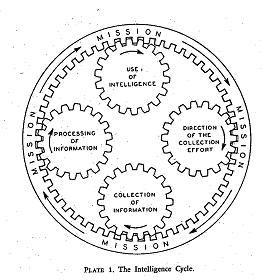
Recently, though, while playing with Google's new Ngram Viewer, I ran across the 1948 book, Intelligence Is For Commanders by LTC Phillip Davidson and LTC Robert Glass.  Both were either instructors or had been instructors at the Command and General Staff College when they wrote the book and it was clearly influenced by the US Army's experience in WWII.

What really intrigued me, though, was their very explicit use of the term, "Intelligence Cycle".  I have scanned in a copy of their cycle and you can see it in the picture at the top of the page.  What is clear from the context of the book is that the intelligence cycle was not a new concept in 1948.  
Just a quick note on Intelligence Is For Commanders:  If you are at all interested in intelligence history and, in particular, military intelligence history, you have to get a copy of this book.  It comes complete with a packet of old school onion skin transparencies that are examples of 1948 analytic methods that later evolved into Intelligence Preparation of the Battlefield  (In fact, one of the authors, Phillip Davidson went on to become the first officer in the Military Intelligence Corps to reach the rank of General).  That is just the tip of the iceberg; for the historically minded, this book is full of interesting tidbits about how intel was done back in the day...
In other research, I have been able to trace some descriptions of the intel process (which sound like the intel cycle but aren't called that) back to the 1920's.  What I am really interested in, though, is who was the first person (or organization) to refer to the intel cycle as the intel cycle and when and why did that happen?

Here's how you can help:

Stories.  When were you first exposed to the intelligence cycle?  Under what circumstances?  I am interested in responses from all three sub-disciplines of intel.  I think it would be fascinating to trace the intel cycle as it migrated through the years from the national security community to the law enforcement and business communities.

Books or manuals.  If you know of any books or manuals that specifically mention the intel cycle, I would be interested and would be particularly interested in any that were written before 1948.  Just give me the names and I will have my team of crack Graduate Assistants track them down.

Any other leads.  This is a bit of a detective story so any ideas that you might have to push the investigation along would be most appreciated.

Finally, I would really like you to leave your story, book or other lead in the comments below so that everyone can follow along.  If you want to contact me directly, though, my email is kwheaton at mercyhurst dot edu.
Enhanced by Zemanta

Monday, January 3, 2011

2011 Predictions Of Interest (Link List)

Cartoon about a fortune teller contacting the ...Image via Wikipedia

The end of the year is always a good time for people and institutions who are in the business of taking a look at the year ahead.  Here are a few lists of predictions that might be of interest to readers of SAM:

Next Year's Wars.  A joint effort of Foreign Policy magazine and the International Crisis Group (and first spotted by the always helpful US Army INTLST...), this list provides some initial insight into 16 possible new crises predicted to erupt in 2011.  The list includes no-brainers such as Iraq and Sudan but also includes some surprises.

Forecast 2011:  Conflict Hotspots.  The International Relations and Security Network has put together an interesting end of year report that highlights Tajikistan, Pakistan and the North Caucasus as places to watch in 2011 among its fairly extensive list of reports and primary resources.

7 Technologies That Will Rock 2011.  Technology is not only of general interest to all of us but of specific interest to intelligence professionals.  One new tool, Quora, discussed in this list by TechCrunch, deserves a special look.

Virtual Worlds Predictions.  I know, I know; virtual worlds seem so ... 2009.  That is pretty much where you would expect them to be given the 2010 Gartner Hype Cycle, though.  It is worth taking a look at this list if only for the government and R and D aspects of this technology.

All these predictions tend to increase uncertainty about the future (well, my uncertainty, at least).  If it does the same for you , take a look at Wired magazine's recent essay on the Uncertainty Effect.  It might not help you feel less uncertain but it may well help you understand your own biases a bit better.

Got other lists worth looking at?  Leave 'em in the comments!
Enhanced by Zemanta