(Note: I am still playing catch-up from a series of conferences I attended over the last several weeks. The post below is taken from notes done at the time of the Games Education Summit. I hope I captured the very good thoughts of the speaker, Ian Schreiber, accurately.)
Ian Schreiber spoke eloquently and at some length at the Games Education Summit about using the principles of game design to construct better learning experiences for our students.
He started his presentation by comparing Pokemon to the periodic table of elements. How is it, he asked, that children will happily remember all of the characteristics of all of the Pokemon characters but not be able to remember any of the characteristics of the periodic table of elements?
Both contain a wide variety of seemingly unrelated information and both are fairly complex yet children as young as 6 and 7 can remember all sorts of things about a Pokemon character and almost none about an element of nature.
What is it about the game that encourages and facilitates learning?
Schreiber did not pretend to have the answer. He readily admitted that game design had no real theory to speak of and made a point of mentioning that 90% of all games are essentially unsuccessful (in that they do not turn a profit).
He did think, however, that there might be some leads in the game design literature that would translate well into instructional design principles.
Specifically he mentioned 3 ideas, Mihaly Csikszentmihalyi's ideas of "flow", Raph Koster's Theory of Fun and Robin Hunicke, Marc LeBlanc, Robert Zubek's 8 kinds of fun.
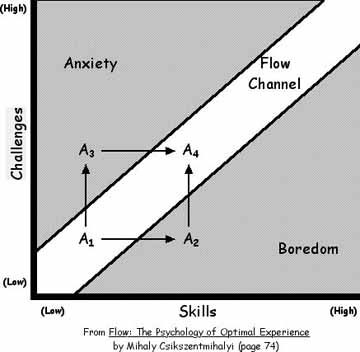
Csikszentmihalyi (a psychologist and not a game designer) argues that learning stuff at the right pace puts us in a "flow" mode that encourages us to learn more. If things are too easy we are bored. If things are too hard, then we quit. We need do-able challenges that allow us to progress, to learn and get better (see image at right). If we have this (or can find it on our own) then we are in the flow.
Schreiber joins this idea to games by way of Koster. Koster's Theory of Fun is as much about learning as it is about games and the book is a perfect segue from the more abstract ideas of Csikszentmihalyi to the world of games.
Finally, Schreiber points us to the 8 different kinds of fun (at least) that are out there. Specifically, these are: Sensation, Fantasy, Narrative, Challenge, Fellowship, Discovery, Expression and Pastime. It is important to understand that fun comes in a variety of sizes, e.g. learning that is "challenging" can also be "fun". Fun does not, in this way of thinking, equal easy.
Schreiber clearly stated that not all classes had to include all the elements of fun. He seemed to be recommending that considering these elements in the design of a class might increase the "fun" in the class and thereby increase the learning.
Beyond these three broad elements, Schreiber pointed to a few additional thoughts that seemed to me to be worth considering. First, he offered a quote from Sid Meier, the designer of the popular Civilization game series (among others): "A good game is a series of interesting decisions." Translating this to the classroom means that these decisions need to be decisions that the students make in the course of the class, not decisions the teacher makes for the students. Furthermore, these decisions do not necessarily have to do with content. Schreiber called the attempt, in some classes, to jazz up the content to make it seem more fun to be little more than "chocolate covered broccoli" (I love this term...).
Schreiber's ideas were thought-provoking and his presentation was well designed and easy to wrap your head around. For more of his ideas, he blogs at Teaching Game Design and
Game Design Concepts.
![Reblog this post [with Zemanta]](https://lh3.googleusercontent.com/blogger_img_proxy/AEn0k_s6_koJOkecnjk74aEOwaRdIumFZt0e8JJ__1fCC0-4d1NHNO2ZRMO1w9CqdKqbJmQdjNoBWkNGCnsVh-r0DBJNmwa55VzsRHwtMJ0p3Iz9x72hpGbZOnq-sJyupELGTGtKYO-mU7nlvSEICLEaJPg=s0-d)
![Reblog this post [with Zemanta]](https://lh3.googleusercontent.com/blogger_img_proxy/AEn0k_trY46q83CzVTNzdftpw3ik9z54NOBvrNAMSFEY2DRNW3wVFI3jwL3NPkFHyZS_4zW9K6S6uwuvxdMknEVSqfT3eWhneavT74TDLUY5-ACZ0xdIcwn20R4U2ZjUy-c1lAOo0Imq22q-GlBMIiFQhaw=s0-d)


![Reblog this post [with Zemanta]](https://lh3.googleusercontent.com/blogger_img_proxy/AEn0k_uMtoeKaAc_OdelOPhxpt8KDmUkhk-aQOigeCoNpW4UWmNB7o5QX4kBHRpFYihC6liadQmqIMmSctVtAzOvCFzl4jUGQoOtdtMpcgVg-DfBXEKBjLMkBX66bcYMSkW9eQg7cVQN5luA85x85EUx05iL=s0-d)


