Monday, June 20, 2011
Is The Games For Change Festival Important To Intelligence Professionals? (Gamesforchange.org)
Posted by
Kristan J. Wheaton
at
1:03 PM
0
comments
Labels: #g4c2011, Game Education Summit, Games for change festival, intelligence, serious games
Tuesday, June 15, 2010
I Am At The Game Education Summit This Week (Liveblogging)
I went last year and it inspired me to try to use games in the classroom. Games-based learning is a growing and fairly well documented field of pedagogy. The Department of Education has even endorsed games-based learning as a powerful teaching tool when employed effectively.
There's the rub -- "employed effectively" -- which is why I am here.
This year I will be presenting my paper on using games to help teach strategic intelligence. I will be posting more on that later but in case you are interested in what I picked up last year, check out the links below:
Live-Blogging The Game Education Summit (Part 1)
What's In A Name? (Part 2)
Open Creativity (Part 3)
Brenda Brathwaite Is Amazing! (Part 4)
Innovative Teaching Through Game Design (Part 5)
Posted by
Kristan J. Wheaton
at
12:19 PM
0
comments
Labels: Game Education Summit, Games based learning, intelligence, strategic intelligence
Tuesday, July 7, 2009
Link List (Games Education Summit 2009)
The Game Education Summit was really an eye-opener for me. It encouraged me to take a look at games in the classroom in a whole new way. If you are interested in some of the other posts in this series, you can see the list below:
Live-Blogging The Game Education Summit (Part 1)
What's In A Name? (Part 2)
Open Creativity (Part 3)
Brenda Brathwaite Is Amazing! (Part 4)
Innovative Teaching Through Game Design (Part 5)
Here are some other links that I found at the Game Education Summit that were interesting:
Game Education Network
Art Institute of Pittsburgh
Panda -- Free game design software
Alice -- Free game design software for beginners
RIP -- a Remix Manifesto
Workbookproject.com -- a social network for those who want to be creative in the digital age
Posted by
Kristan J. Wheaton
at
9:37 AM
0
comments
Labels: Brenda Brathwaite, Game design, Game Education Summit, Game Studies, Games
Monday, July 6, 2009
Innovative Teaching Through Game Design (Games Education Summit -- Part 5)
(Note: I am still playing catch-up from a series of conferences I attended over the last several weeks. The post below is taken from notes done at the time of the Games Education Summit. I hope I captured the very good thoughts of the speaker, Ian Schreiber, accurately.)
Ian Schreiber spoke eloquently and at some length at the Games Education Summit about using the principles of game design to construct better learning experiences for our students.
He started his presentation by comparing Pokemon to the periodic table of elements. How is it, he asked, that children will happily remember all of the characteristics of all of the Pokemon characters but not be able to remember any of the characteristics of the periodic table of elements?
Both contain a wide variety of seemingly unrelated information and both are fairly complex yet children as young as 6 and 7 can remember all sorts of things about a Pokemon character and almost none about an element of nature.
What is it about the game that encourages and facilitates learning?
Schreiber did not pretend to have the answer. He readily admitted that game design had no real theory to speak of and made a point of mentioning that 90% of all games are essentially unsuccessful (in that they do not turn a profit).
He did think, however, that there might be some leads in the game design literature that would translate well into instructional design principles.
Specifically he mentioned 3 ideas, Mihaly Csikszentmihalyi's ideas of "flow", Raph Koster's Theory of Fun and Robin Hunicke, Marc LeBlanc, Robert Zubek's 8 kinds of fun.
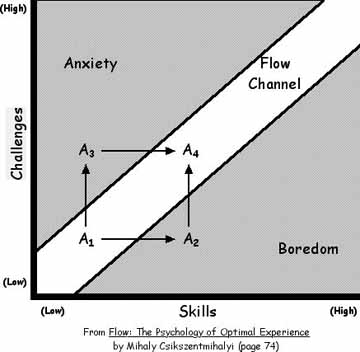
Csikszentmihalyi (a psychologist and not a game designer) argues that learning stuff at
the right pace puts us in a "flow" mode that encourages us to learn more. If things are too easy we are bored. If things are too hard, then we quit. We need do-able challenges that allow us to progress, to learn and get better (see image at right). If we have this (or can find it on our own) then we are in the flow.
Schreiber joins this idea to games by way of Koster. Koster's Theory of Fun is as much about learning as it is about games and the book is a perfect segue from the more abstract ideas of Csikszentmihalyi to the world of games.
Finally, Schreiber points us to the 8 different kinds of fun (at least) that are out there. Specifically, these are: Sensation, Fantasy, Narrative, Challenge, Fellowship, Discovery, Expression and Pastime. It is important to understand that fun comes in a variety of sizes, e.g. learning that is "challenging" can also be "fun". Fun does not, in this way of thinking, equal easy.
Schreiber clearly stated that not all classes had to include all the elements of fun. He seemed to be recommending that considering these elements in the design of a class might increase the "fun" in the class and thereby increase the learning.
Beyond these three broad elements, Schreiber pointed to a few additional thoughts that seemed to me to be worth considering. First, he offered a quote from Sid Meier, the designer of the popular Civilization game series (among others): "A good game is a series of interesting decisions." Translating this to the classroom means that these decisions need to be decisions that the students make in the course of the class, not decisions the teacher makes for the students. Furthermore, these decisions do not necessarily have to do with content. Schreiber called the attempt, in some classes, to jazz up the content to make it seem more fun to be little more than "chocolate covered broccoli" (I love this term...).
Schreiber's ideas were thought-provoking and his presentation was well designed and easy to wrap your head around. For more of his ideas, he blogs at Teaching Game Design and
Game Design Concepts.
Posted by
Kristan J. Wheaton
at
10:32 AM
1 comments
Labels: Game design, Game Education Summit, Marc LeBlanc, Mihaly Csikszentmihalyi, Raph Koster, Sid Meier
Wednesday, June 17, 2009
Brenda Brathwaite Is Amazing (Game Education Summit -- Part 4)
Everyone has played a game that was enormously engrossing; that became the focus of their lives for at least a short period.
Everyone has had at least one great class in their lives, where, at the end, they "got it"; where they learned the lesson deeply on both an intellectual and emotional level.
Everyone, finally, has seen a work of art that communicated, through its attention to detail, a broad, deep message.
Brenda Brathwaite, a professor of game design at the Savannah College of Art and Design has accomplished all three of these goals in a single "installation" -- and she has done it not once, but twice.
I used the word installation above because I cannot think of a better term for what Brathwaite has done. It is not a good word because it conveys no sense of the dynamic quality inherent in her work. Artists would call it art and educators would no doubt see it as an incredibly effective way to teach a lesson.
Brathwaite is a professional game designer, however, with scads of popular video games to her credit and she proudly refers to these as games. I say "proudly" because one of her explicit goals was to show that games could educate, be seen as art and still be good games. She seemed to me to want to push her understanding of the limits of her discipline in ways that few within the discipline would recognize.
The first game is called Ni ceart go cur le cheile (Where my people come from in Gaelic) though it is invariably referred to as "The Irish Game". It is a game that explores the Cromwellian conquest of Ireland in the 1600's. In it, the players participate as Irish factions trying to manage the displacement of their people in the face of a relentless British invasion. Failure to find room in a country that is rapidly running out of space results in some of the Irish inevitably getting sent to Barbados as slaves -- a fate that befell many at this time. The faction that loses the least wins.
At some trivial level, this game is like lifeboat (you get thrown off the boat; you get thrown off the island) or, as I clumsily suggested, the zombie level in Call of Duty 5 (relentless assault where you cannot win, only lose the the least).
A single second imagining the playing pieces as members of a family displaced, dispersed or abandoned to the fate of slaves brings a different lesson crashing home. People -- it becomes hard to think of them as game pieces -- had to decide where to go, had to uproot their lives, abandon their property, increasingly move to areas where there were more and more people and fewer and fewer resources.
The game design doesn't allow for momentary pangs of discomfort, however. Each turn, the toll increases; each turn the lesson becomes less of a historical artifact and more real for the student.
The game board (the photo at the right does not do it justice) and associated pieces are filled with the kind of detail that it is hard not to appreciate. The Irish pieces are the "right" color of green, the British pieces the right color of orange. The smooth, sleek beveled glass separating the playing pieces from the ground below is a stark contrast to the burlap "board" that drives much of the game play.
Brathwaite's ability to explore historic and tragic events through the medium of the game is not limited to her own Irish heritage. Her other game/installation on display here at the Game Education Summit is, if anything, more powerfully rendered.
In this game, called Train (see the photo to the right), Brathwaite asks the players to move 60 yellow playing pieces -- "people" -- down one of three tracks to their destination as quickly as possible. Along the way, the players draw cards that result in delays or events which accelerate the trains. To overcome these obstacles, players are encouraged to exhibit an almost ruthless efficiency, to carefully balance the risks and rewards of various strategies to accomplish the goal in the most rapid way possible.
There is a strong physical component to the play as well. The playing pieces do not fit nicely into the toy trains so filling the train cars to the maximum capacity requires players to jam the pieces in. The payoff is obvious. The more pieces jammed into the cars the fewer trips the cars will have to make.
Each time a car arrives at the end of the line, the player draws a card that tells them where the train ended up. In stark black and white the game reveals itself on each card turned over -- Dachau, Bergen-Belsen, Auschwitz...
Then back to the beginning to fill another car.
Again, the attention to detail in the game itself puts the game in the realm of art as well. The three pages of rules were typed on an old SS typewriter purchased specifically for the purpose. The rules themselves help reveal the story (players are required to take a hammer and break a piece of glass before each game). There are few other games that I can think of (Hush is one) that can begin to generate this type of emotion.
Finally, what makes Brathwaite truly amazing is her ability to explain what it is she has done. She is clearly able to communicate to artists on the level of art, gamers on the level of the game and educators on the hidden power of her medium to teach at depth few other techniques can match.
Posted by
Kristan J. Wheaton
at
12:07 PM
0
comments
Labels: Board game, Brenda Brathwaite, Game design, Game designer, Game Education Summit, Games, Ireland, Savannah College of Art and Design, Video game
Open Creativity (Game Education Summit -- Part 3)
Lance Weiler and Vicki Callahan talked about their concept of open creativity. Open creativity, as I understood it, was the explicit integration of the audience, players, viewers, students, whatever into the creative process in a transmedia environment. Transmedia, in turn, is the term these guys used to describe what I think Flint Dille is also getting at in The Blur.
The essential element of both open creativity and The Blur seems to me to be that content providers (including teachers) can no longer expect to engage their audience, players, students, etc. through only one media. You can't just make a film, for example and be done with it. You need to have a book and a documentary and a game, etc.
In addition, you cannot expect the audience, players, students, etc to remain passive in the process. They are going to want to participate in (or, at least, have a window into) your process. Weiler probably put it best when he called open creativity an evolution in storytelling involving both amateurs and professionals.
I see something analogous to this in the modern classroom all the time. It revolves around the concept of peer learning. It is one of the most powerful and under-utilized tools in modern education. You almost never see a lesson plan that explicitly takes into account or incorporates peer learning yet almost every teacher depends upon it.
Peer learning has, in fact, been brought up several times in this conference. Not in those terms exactly but it often permeates the presentations. Don Marinelli, yesterday's keynote speaker flat came out and said the the reason behind his program's success was that they let the students be the teachers.
Now, that is all well and good but there has been little talk about what that means or how to implement that in the classroom. This is ultimately why I found the open creativity presentation so interesting. Here is the logic: If the game design analogue of peer learning is open creativity, then what lessons from open creativity can I bring back to the concept of peer learning?
- Think of learning as a social experience. I am not suggesting that individual reflection is not an essential part of learning but, currently, there seems to be a unwarranted bias towards modes of learning that emphasize individual activities over group activities. Part of this is due to philosophy and part is due to problems of classroom management but the lesson being implicitly taught here is that games may well be a way to overcome this.
- See the students as collaborators. This not only plays into their preferences it also helps them begin to model their behavior along professional lines. Modeling behavior is a powerful learning tool. Students, for example, who see themselves as scientists rather than as students, do much better in science classes.
- Plan for multiple levels of interactivity and "unlock" new content as the students achieve. "Unlocking content" is a very game-ish term; e.g. kill the big monster and get a new sword or open up a new story line. I am not sure how this translates into the classroom but I am interested in exploring how the idea of "unlocking content" might change how I teach my courses.
- Franchise your content. Even Weiler and Callahan weren't sure what this means but they seemed to be pushing towards a time where amateurs who had contributed adequate time and effort into a creative project might derive benefits more tangible than a t-shirt or free tickets. Education already does this to an extent. Peer tutors are often paid and one could see the granting of a degree (particularly a masters or doctorate) to be a license to teach the same material to others. Again, the interesting possibilities emerge from thinking about this activity explicitly as a franchise instead of more traditional ways.
Posted by
Kristan J. Wheaton
at
10:30 AM
0
comments
Labels: Creativity, education, Flint Dille, Game Education Summit, intelligence, Teacher
Tuesday, June 16, 2009
What's In A Name? (Game Education Summit -- Part 2)
Don Marinelli kicked off the Game Education Summit with a rousing "hoo-ah" speech for the academics and game design professionals in the room. He wasn't entirely preaching to the choir but it certainly seemed he knew his audience.
Beyond the high rhetoric (such as video games are the "Lucifer of Liesure" to naysayers and luddites...) there were a number of interesting points he brought up. Rather than focus on the entire speech (which, as I mentioned, was designed as much to inspire as to inform), I intend to simply hit the high points from my perspective:
The intersection between games and education. Marinelli was primarily talking about teaching game design at the University level but he spent a good bit of the speech highlighting the more general importance of games in education. He was quite passionate about it and I think generally correct. Games excel at implicit learning -- learning without knowing that you are learning. Taking advantage of that makes sense.
The inevitability of game-based learning. The shift to game based learning in Marinelli's view is largely generational. As the currnet generation (comfortable with chalkboards, lectures and linearity in general) gives away to the next (comfortable with GPS, SMS and high speed internet) there will inevitably be a shift in the way we educate people. Students want to know that they invested their youth wisely. I couldn't help but think at this point of various theories about why animals play. At least one of the theories is that they play to learn.
Intelligence studies and game design share a similar problem -- perception. Marinelli seemed to be saying that games are considered "fun" and game deigners too often feel like they have to apologize for their profession. Likewise, it occurred to me that intelligence is all too often considered "bad" and intelligence professionals similarly feel a need to apologize for their profession (It actually happened to me here. I asked a question and the presenter asked back, "What is it you teach?" My answer: "You don't want to know." And the cock crowed the first time...).
Posted by
Kristan J. Wheaton
at
9:24 AM
0
comments
Labels: education, Game design, Game Education Summit, Game Studies, Games, intelligence, Learning, Learning Theories, Methods and Theories, Video game
Monday, June 15, 2009
Liveblogging The Game Education Summit! (Carnegie Mellon University)
For the next couple of days I will be live blogging at the Game Education Summit at Carnegie Mellon University. The conference is billed as the place where the games industry and academia comes together.
You can find out more about the conference at the conference website and they will be live streaming the keynotes today and tomorrow.
Personally, I am not sure what I expect to get out of this conference. I have always believed that games are a good -- perhaps the best -- way to learn. This is particularly true for things like strategy and I am specifically looking for a way to work some games into my strategic intelligence course.
Stay tuned!
Posted by
Kristan J. Wheaton
at
10:08 PM
0
comments
Labels: Carnegie Mellon University, education, Game Education Summit, technology