Showing posts with label intelligence analysis. Show all posts

Wednesday, October 10, 2018

6 Things To Think About While Discussing Requirements With A Decisionmaker (Part 5 and 6)

"Jeeves, I am fairly certain that is not what Prof. Wheaton had in mind
when he said we need to constrain the requirement."
How can I use the limited amount of time my decisionmakers have to discuss their intelligence requirements to get the maximum return on that investment?  Earlier this summer, I began a series on this precise theme.

I have already written about how to prepare for an intelligence requirements meeting and about how to deal with a virtual intelligence requirements environment.

You can also see the first four articles on things to think about when having a requirements meeting with a decisionmaker (DM) at the links below:

1.  Does the DM really want intelligence?
2.  What kind of intelligence is the DM looking for?
3. What are the DM's assumptions?
Today, I am writing part five and six of this six part epic discussing what intel professionals need to think about when they are actually in the meeting, talking to a decisionmaker about his or her requirements.

5. What constraints is the DM willing to put on the requirement?

I once had a DM who was looking to expand his local business and asked for a nationwide study.  His business was based on serving local customers and he did not have the resources to go nationwide and yet...  

Decisionmakers are notoriously reluctant to put constraints on requirements.  They worry that, if they do, just on the other side of whatever bright line they think they have drawn, there will be a perfect customer for their business, a critical fact that lets them make a foolproof plan to defeat the enemy, or the key piece of info that solves all their problems.  I call this the "pot of gold" syndrome and it afflicts every decisionmaker.  


This worry, of course, blinds these same decisionmakers to the inevitable problem this approach causes:  Given the constant limitations on time and resources, trying to look everywhere makes it difficult for the intelligence unit to look anywhere in depth.  Knowing the areas that are of genuine interest and can genuinely support the decisionmaker helps get the most out of the intelligence effort.  Likewise, knowing where you don't need to look is equally helpful.


There are at least six different kinds of constraints that intelligence professionals need to address when engaged in a discussion about requirements:
  • Geography.  What are the limits to how far we need to look?  Where can we draw lines on our maps?  Geography is used loosely here, by the way.  Understanding and constraining the "market landscape" or the "cyber landscape", for example, also fall within this guidance.
  • Time.  How far forward do you want us to look?  Every problem has a "predictive horizon" beyond which it is hard to see.  Moreover, you will likely see a good bit more detail with a good bit more confidence if you are looking one month out instead of 10 years out.
  • Organizational units.  At what level does the DM want the analysis?  Am I looking at industries, companies or departments within companies?  Countries, regions, or continents?  
  • Processes, functions.  Are there certain processes or functions of the target that the DM cares more about than others?  Are there processes or functions that we could ignore?  For example, imagine a company that doesn't care how its competitor manages its HR but really wants to know about its supply chain.
  • People.  Which people in the target organization are most important to the DM (if any)?  Are we looking at the government of a country or the president of a country?  A competitor or the CEO of that competitor?  Obviously, "both!" might be right answer but asking the question makes it clear to both the DM and the intel unit.
  • Money.  Are there amounts of money about which we do not care?  Do you want me to try to look at every drug transaction or just the large ones?  Is every act of bribery, no matter how trivial, really worth spending the time and energy on in a study of a country's level of corruption?  Again, the answer in both cases may be "yes!" but without asking, the intel unit runs the risk of failing to provide the level of analysis the DM wants and will almost inevitably waste time analyzing issues that the DM cares little about.
6. What are the DM's priorities?

In any sort of robust requirements discussion, it is normal for many more requirements to emerge than the intelligence unit can handle.   Rather than complain about all the work, a better way to handle this is to get the DM to state his/her priorities.  

I have worked with hundreds of DMs and all of them understand resource constraints.  Even with quality intel analysis, I have often seen teams disappoint a DM when they have to say, "We didn't have time/money/people to get to all of your requirements."  I have never, however, seen a DM disappointed when that team can say, "We didn't have time/money/people to get to all of your requirements, but we were able to address your top 5 (or 10 or whatever) requirements."

The key to being able to address the top priorities, however, is knowing what they are.  As with all constraints, DMs are typically hesitant to prioritize their questions.  They may feel that they do not know enough to do so.  They may also be worried that the intelligence unit will put on blinders such that they will only look at the priorities and forget to keep an eye out for unexpected threats and opportunities.  

One of the keys here is to not make assumptions about priorities.  Even if the DM sends the team a numbered list, it makes sense to go back and ask, "Are these in priority order?"  Almost every time I have asked that question - forcing the DM to actively think about their priorities - I get changes to the order.  Likewise, just because a DM talks a lot about a certain issue, do not assume that it is the top priority.  It may just be the most recent thing that has come up or a new idea that the DM just had.  Asking, "We have talked about X quite a bit.  Is this where you would like us to focus?" is still important.

Priorities are an enormously powerful tool for an intelligence unit. They allow the unit to focus and to make tough decisions about what is relevant and what is not.  Don't leave your requirements meeting without them!

Next:  Four Things You Must Do After A Requirements Meeting

Wednesday, September 24, 2014

Advanced Analytic Techniques (The Blog) Is Back!

Check out www.advat.blogspot.com!
Each year, I teach a class called Advanced Analytic Techniques (AAT) here at Mercyhurst.  It is a seminar-style class designed to allow grad students to dig into a variety of analytic techniques and (hopefully) master one or two.   

The students get to pick both the topic and the technique on which they wish to focus so you wind up with some pretty interesting studies at the end.  For example, we have applied the traditional business methodology of "best practices" to western European terrorist groups and the traditional military technique of Intelligence Preparation of The Battlefield to the casino industry.

As you can imagine, some of these projects gain a bit of notoriety for their unique insights.  One of my former students, Jeff Welgan, even had his AAT project written up in the book Hyperformance.

Beyond this deep dive that each student is required to do, the class is also designed to teach students how to evaluate analytic techniques for things such as validity and flexibility.  To help with this process, each week we take a quick look at an analytic technique that no one in the class is using in their projects.  

We start this process with a tour d'horizon of the available literature on the method with a particular focus on the literature that is higher up the evidence pyramid and relevant to intelligence analysis.  At the end of the week, one member of the class runs an abbreviated demo of the technique using the other half of the class as guinea pigs.  Once we are done, we all sit down and write up our thoughts about the method.  Last week, for example, we took a (quick) look at SWOT.  This week we will be examining various forms of Red Teaming.

All of this - the summaries and critiques of the articles we have found, and our overall "evaluation" of the technique - gets posted onto the Advanced Analytic Techniques blog each week.  Over the years, the blog has become increasingly popular and I certainly encourage everyone to take a look and, if you have a comment, join in!

Wednesday, April 9, 2014

Help! Where Can I Find A Job?? (RFI)

I am in the process of updating and compiling my list of job resources for entry-level intelligence analysts and I could use your help!  

If you  know of any good websites or resources, please either send them to me (kwheaton at mercyhurst dot edu) or post them in the comments below.  

What kind of links am I looking for?

  • Job links for entry-level intelligence analysts.  If you know of a company or organization that has intelligence analyst jobs on the books that can be filled by an entry-level analyst, send a link.
  • Job links for intelligence analyst-like positions.  Lots of positions within the private sector (such as anti-money laundering positions with most banks) are good fits for entry-level intelligence analysts but they are rarely easy to find through straightforward job searches.  
  • Job links for international positions (for nationals and expatriates).  There doesn't appear to be a good list of job resources for individuals with intelligence analyst skills who want to work outside their native country.  Likewise, expatriates often having a hard time finding intelligence-like jobs in foreign countries.
  • Job links for Non-Governmental Organizations.  NGO's rarely if ever title analyst positions as "intelligence" positions, yet the intelligence analyst skill set is often the best fit.

Beyond job boards or specialist search sites, what else can you provide?  Job preparation resources.  Getting a job in any intelligence position in challenging.  Any hints or tips that are particularly relevant to the intel job search would be appreciated.  What kind of stuff am I talking about?

  • Interview skills
  • Resumes
  • Social Media Usage/Presence (LinkedIn in particular)
  • Job Fairs
  • Hints and tips for breaking in
Once I get everything compiled, I will post the list here!

Tuesday, March 25, 2014

Reduce Bias In Analysis: Why Should We Care? (Or: The Effects Of Evidence Weighting On Cognitive Bias And Forecasting Accuracy)

We have done much work in the past on mitigating the effects of cognitive biases in intelligence analysis, as have others. 

(For some of our work, see Biases With Friends, Strawman, Reduce Bias In Analysis By Using A Second Language or Your New Favorite Analytic Methodology: Structured Role Playing.)
(For the work of others, see (as if this weren't obvious) The Psychology of Intelligence Analysis or Expert Political Judgment or IARPA's SIRIUS program.)

This post, however, is indicative of where we think cognitive bias research should go (and in our case, is going) in the future. 

Bottomline: Reducing bias in intelligence analysis is not enough and may not be important at all. 

What analysts should focus on is forecasting accuracy. In fact, our current research suggests that a less biased forecast is not necessarily a more accurate forecast.  More importantly, if indeed bias does not correlate with forecasting accuracy, why should we care about mitigating its effects?

In a recent experiment with 115 intel students, I investigated a mechanism that I think operates at the root of the cognitive bias polemic: Evidence weighting. 

Having surveyed the cognitive bias literature, key phrases began to stand out such as:
A positive-test strategy (Ed. Note: we are talking about confirmation bias here) is "the tendency to give greater weight to information that is supportive of existing beliefs" (Nickerson 1998). In this way, confirmation bias not only appears in the process of searching for evidence, but in the weighting and diagnosticity we assign to that evidence once located.
The research of Cheikes et al. (2004) and Tolcot et al. (1989) states that confirmation bias "was manifested principally as a weighting and not as a distortion bias." Further, the Cheikes article indicates that "ACH had no impact on the weight effect," having tested both elicitations of the bias (in both evidence selection and evidence weighting). 
Emily Pronin (2007), the leading authority on Bias Blind Spot, presents a similar conclusion: "Participants not only weighted introspective information more in the case of self than others, but they concurrently weighted behavioral information more in the case of others than self."
Robert Jervis, professor of International Affairs at Columbia University, speaks about evidence-weighting issues in the context of the Fundamental Attribution Error in his 1989 work Strategic Intelligence and Effective Policy.
What if the impact of bias in analysis is less about deciding which pieces of evidence to use and more about deciding how much influence to allocate towards each specific piece?  This would mean that to mitigate the effects of cognitive bias and to improve forecasting accuracy, training programs should focus on teaching analysts how to weight and assess critical pieces of evidence.

With that question in mind, I designed a simple experiment with four distinctly testable groups to assess the effects of evidence weighting on a) cognitive bias and b) forecasting accuracy. 

Each of the four groups were required to spend approximately one hour conducting research on the then-upcoming Honduran presidential election to determine a) who was most likely to win and b) how likely they were to win (in the form of a numerical probability estimate, e.g. "X is 60 percent likely to win"). Each group, however, used varying degrees of Analysis of Competing Hypotheses (ACH), allowing me to manipulate how much or how little the participants could weight the evidence. A description of each of the four groups is below:
  • Control group (Cont, N=28). The control group was not permitted to use ACH at all. They had one hour to conduct research independently with no decision support tools. 
  • ACH no weighting (ACH-NW, N=30). This group used ACH.   Participants used the PARC 2.0.5 ACH software without the ability to use II (highly inconsistent) or CC (highly consistent) functions. Nor were they allowed to use the credibility or the relevance functions.
  • ACH with weighting (ACH-W, N=30). This group used ACH as they had been instructed, including II, CC and relevance, but not credibility.
  • ACH with training (ACH-T, N=27). This was the focus group for the experiment. Participants in this group, which used ACH with full functionality (excluding credibility), first underwent a 20-minute instructional session on evidence weighting and source reliability employing the Dax Norman Source Evaluation Scale and other instructional material. In other words, these participants were instructed how to weight evidence properly. 
While the election prediction served as the metric for assessing forecasting accuracy (the experiment was conducted two weeks before the election), five separate instruments were used in the form of a post-test in order to elicit bias, three of which corresponded with confirmation bias, one which addressed the framing effect and then, finally, representativeness. 

The results were intriguing:

The group with the most accurate forecasts (79 percent) was the control group, or the group that did not use ACH at all (See Figure 1). The next most accurate group (65 percent) was the ACH-T group, or the ACH "with training." 


Figure 1. The Effects of Evidence Weighting Across Four Groups on Forecasting Accuracy and Cognitive Bias.
Note: The percentage for each bias represents the percentage of unbiased responses obtained in that group.
Due to the small sample sizes, these differences did not turn out to be statistically significant which, in turn, suggests the first major point:  That training in cognitive bias mitigation and some structured analysis techniques might not be as useful as originally thought.  

If this were the first time these kinds of results had been found, it might be possible to chalk it up to some sort of sampling error.  But Drew Brasfield found much the same thing when he ran a similar experiment back in 2009  (The relevant charts and texts are on pages 38-39).  In Brasfield's case, participants were statistically significantly less biased when they used ACH but forecasting accuracy remained statistically significantly the same (though, in this experiment, the ACH group technically outperformed the Control).

These results also suggest that more accurate estimates came from analysts who either a) intuitively weighted evidence without the help of a decision tool or b) were instructed how to use the decision tool with special focus on diagnosticity and evidence weighting. This could mean that analysts, when given the opportunity to weight evidence without knowing how much weighting and diagnosticity impacts results, weight incorrectly out of perceived obligation to do so or misunderstanding.

Finally, the next lowest forecasting accuracy was obtained by the group ACH-NW (53 percent) in which the analysts were not allowed to weight evidence at all (no IIs or CCs). The lowest accuracy (only 45 percent) was obtained by the group that was permitted to weight evidence with the ACH decision tool but were not instructed how to do so nor were they informed how this weighting might influence the final inconsistency scores of their hypotheses.  This final difference was statistically significant from the control suggesting that a failure to train how to weight evidence appropriately actually generates lower forecasting accuracy.

If that weren't enough, let's take one more interesting look at the data...

In terms of analytic accuracy, the hierarchy is as follows (from most to least accurate): Control, ACH-T, ACH-NW, ACH-W.

Now, in terms of most biased, the hierarchy looks something like this (from least to most biased):
  • Framing: ACH-T, ACH-W, ACH-NW, Control
  • Confirmation: ACH-W, ACH-T, Control, ACH-NW
  • Representativeness: ACH-W, ACH-NW, Control, ACH-T
What this shows is an (albeit imperfect) inverse to analytic accuracy. In other words, the more accurate groups were also more biased, and while ACH generally helped mitigate bias, it did not improve forecasting accuracy (in fact, it may have done the opposite). If this experiment achieved its goal and effectively measured evidence weighting as an underlying mechanism of forecasting accuracy and cognitive bias, it supports the claim made by Cheikes et al. above: "ACH had no impact on the weight effect" (again, talking about confirmation bias) and, as mentioned, recreates the results found by Brasfield. 

While the evidence weighting hypothesis is obviously in need of further investigation, this preliminary experiment provided initial results with some intriguing implications, the most impactful of which is that, while the use of ACH reduces the effects of cognitive bias, it may not improve forecasting accuracy. A less biased forecast is not necessarily a more accurate forecast. 


***
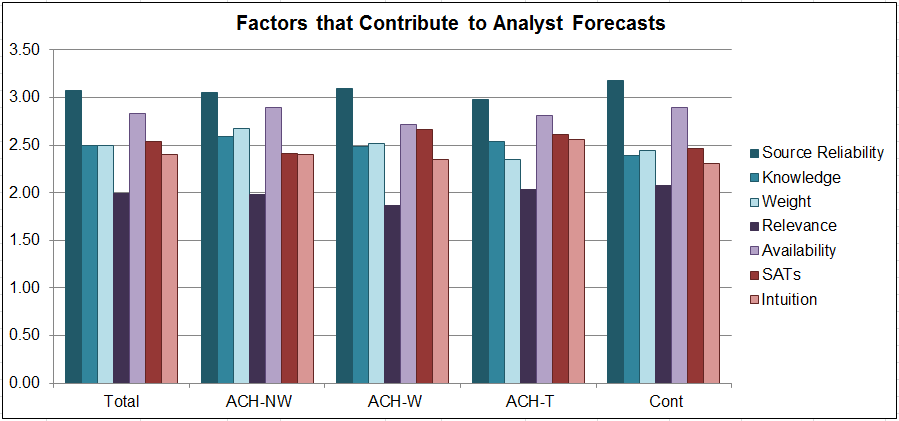
As a side note, I wanted to include this self-reported data which shows the components that the 115 analysts in this experiment indicated were most influential in their final analytic estimates in general. Note that they indicate that source reliability and availability of information seem to be the top two (See Figure 2).

Figure 2. Self-Reported Survey Data of 115 Analysts Indicating Factors That Most Influence Their Analytic Process
Scale = 1 - 4

REFERENCES

Cheikes, B. A., Brown, M. J., Lehner, P. E., & Adelman, L. MITRE, Center for integrated intelligence systems. (2004). Confirmation bias in complex analyses (51MSR114-A4). Bedford, MA.

Jervis, R. (1989). Strategic intelligence and effective policy. In Frank Cass (Ed.), Intelligence and security perspectives for the 1990s. London, UK.

Nickerson, R. S. (1998). Confirmation bias: An ubiquitous phenomenon in many guises. Review of general psychology, 2(2), 175-220.

Pronin, E., Gilovich, & Ross, L. (2002). The bias blind spot: Perceptions of bias in the self versus others. Personality and social psychology bulletin, 28, 369-381.

Pronin, E., & Kugler, M. B. (2007). Valuing thoughts, ignoring behavior: The introspection illusion as a source of the bias blind spot. Journal of experimental social psychology, 43, 565-578.

Tolcott, M. A., Marvin, F. F., & Lehner, P. E. (1989). Expert decisionmaking in evolving situations. IEEE transactions on systems, man, and cybernetics, 19(3), 606-615.

Monday, March 3, 2014

What The Syrians Had To Say: Views from Istanbul (Part 5 Of A Multi-Part Series)

First of all, thank you to those who have stuck with us through this lengthy series on network analysis and Turkey. This will be the final installment, though the projects are still ongoing and the techniques still being refined and applied. 

Below are the stories from Syrians that have fled the country, collected by the author in January 2014. 

For those who missed the first four pieces, they can be found here: My Conversation With The Free Syrian Army, Ethnolinguistic Mapping, Gravity Model Analysis, and Population Simulations.

All the methodology involved in this lengthy project was recently presented at the International Network For Social Network Analysis Sunbelt Conference, and very well received (a big thanks to a very special CENTCOM Sunbelter who made the presentation and the trip to Turkey all possible). 

The methods led to very intriguing conclusions, some of which were confirmed and some of which were challenged by the Syrian refugee population in and around Istanbul, Turkey. In the suburbs of Istanbul, I spoke with many refugees to gain perspective on everything from their geographic movement to their political opinions, and what they had to say was equally as heartbreaking as it was informative. 

A woman held a one year, seven-month old child in her arms as she spoke to me in Arabic. "She is a living marker of the revolution," she told me. "She was just one month old when we left Syria; her life has only seen the war." 

Children playing outside for recess at a Syrian day school in Bayramtepe

A single mother of three, this woman had been living in an apartment in Fatih district of Istanbul since early 2013. The last time she had heard that her husband was alive after being incarcerated in Aleppo was March 2013. 

"We agreed before we left Syria," she said, "that if either one of us was killed or put in jail, the other one would continue to Istanbul." 

"Do you intend to stay in Istanbul?," I asked.

She replied that she could not leave. She hopes every day that her husband is alive, and if he is and escapes, he will only know to find her here. "I send money back to Aleppo for people to pay to the prison guards to ask about my husband. They take the money, but I never hear anything back." 

She was a woman of higher socioeconomic status, obvious from her black silk hijab. Many people living in Istanbul, namely the district of Fatih, are of a higher socioeconomic standing than those out in the suburbs, like Bayramtepe. 

Of all the people I interviewed, a total of 22 families and 152 individuals (about half of them children), there was a clear difference between groups of both lower and higher socioeconomic statuses. Those of the former group responded that they hoped to return to Syria as soon as possible. When asked what their ideal outcome would be, they replied that who would be in power in Syria did not matter, only that it was safe enough to return. 

Those of a higher socioeconomic status indicated that they did not intend to return to Syria. They were bitter and angry.

"Why would I go back?," one man shouted at me. "I have lost everything! There is nothing there for me and my family!"

"What would you like to see happen in Syria, politically," I pressed, despite his challenging tone. 

"Assad has treated the Syrian people like animals," he replied. He spoke of the need for international intervention. He expressed his disbelief at the U.S. government's lack of initiative in the region. "And this Geneva conference..." he continued, "they are just playing their game." He spit these last words at me before taking a sip of the Turkish tea his son's wife had made for us on arrival. 

This interaction was representative of the class divide among those with whom I spoke. 

The following day I walked through Bayramtepe, sun setting quickly around 1600 behind rolling hills littered with cinder blocks and the occasional haggard donkey. Crawling out of the muddy streets and up the cement stairs to a shack on stilts, I was overwhelmed with the smell of garlic and cooked greens as the door opened. A chorus of Salaam Alaikum filled the entryway as I pried my muddy boots off my feet for about the 20th time that day.

It was a single room with a drafty roof, but it was cozy, with a pot in the center that contained simmering green leaves. Many children, too many to count, ran in and out of the house as a woman, upwards of 95, tottered around yelling at them to keep quiet for the guests. She brought out an apple on a tray for the seven of us to share.

"We walked," she told me, "first from Damascus, then to Raqqa where we crossed the Turkish border at Tel-Abyad." 

"What was the most difficult part of your trip?," I asked. 

She mentioned walking all that way with all the children (more than 10) and her mother, who was ill (the 95-year old woman who was surprisingly lively and cheerful, excited to have company). 

"Also," she pressed on after she had contained her tears enough to continue, "when we crossed the border, the Turkish police caught us on the other side. None of us had passports, so they returned us back to Syria. We had to wait for them to leave before sneaking across the border the following night."

This was a common story I heard from the refugees. Almost none had passports or citizenship papers. Many were captured and returned to Syria, but then sneaked over the border later. 

"My life was saved by an American," a man later told me.

This was intriguing.

"I was captured near Aleppo by the Syrian government, and put in jail with my family. We stayed there for a few days until another man was put in jail with us. An American, I think. He spoke only in English. Later that day, I heard the military talking and the captured man was someone of great importance, so the Syrians took us all, my family and the man, and left us out in the middle of the country near Aleppo. They just drove away. I was lucky."

Thoughts of who this man might have been flashed through my mind. A journalist, perhaps? An international peacekeeper? Someone the Syrians did not want to be responsible for incarcerating. 
Bayramtepe, Turkey


The refugees were from Aleppo, Raqqa, Homs, Idlib and Damascus. They had come to Istanbul looking for work, some by way of Cairo. It was encouraging to hear that those that had crossed the border between Syria and Turkey had all crossed at the precise locations used in my simulations. 

I also learned that most traveled on foot through Syria and then by bus from Turkish border towns to Istanbul. The factors in my simulation reflected railways and roadways. In retrospect, railways were unnecessary, where roadways were important, but so pervasive throughout such a developed country that the factor hardly would have made a difference. It is through these valuable insights that I can now alter the factors in the simulation to better represent the region hosting the population and the characteristics of the population itself. 

A final surprise from Istanbul was the groups of people that I encountered. I expected to find Shia Kurds, Christians and Alawites, all minorities in the Sunni Muslim refugee camps near the border. What I found were both Sunni and Alevi (Shia) Kurds, some Sunni Muslims and no Christians. Where were the Christians?

Granted, I had assumed they would be in Istanbul by process of elimination. They did not go to Jordan, Lebanon or Iraq, but preferred Turkey's more secular environment. They were not in the refugee camps near the border, though, so I assumed they must be among those migrating to Istanbul. After speaking with those who knew the entire Syrian population in Istanbul and its suburbs I determined there were no Christians in the area. Where were the Christians? News articles answered the question for me once I got home.

In speaking with a man named Azzad, the leader of a private Syrian refugee organization in Bayramtepe that survives on donations from Turkish citizens, he indicated that he had registered 2,500 families, upwards of 12,000 people, with 5 - 10 new families arriving daily. He said that no one leaves and everyone needs help. The majority of the refugees are Kurds.

A man named Muffa who runs the same kind of organization in Fatih district of Istanbul indicated he had 5,500 families in the city with 100 new families registering every month. 

"If I had to guess," he told me, "about 20 percent of the people in Fatih are Kurdish." 

These are just some of the many stories from the refugees that I spoke with representing the ways in which they challenged and confirmed my analytic predictions. 

While I continue to follow the crisis in Syria, my current research involves the application of the methods presented in this multi-part series to central Africa. The utility of the methodology developed is its flexibility, but different regions and refugee groups require a comprehensive re-evaluation of the factors influencing the simulation. 

With luck, look for the information on Central Africa to surface sometime early summer!

Monday, December 23, 2013

A Christmas Card With A Secret

As a 'Happy Holidays' from SAM, we bring some cheerful holiday pictures that are a bit more than meets the eye. Yes, they are Christmas trees, but they are also intel!


Population Movement Simulation Results 1 

Consider this a teaser for what is to come from SAM in the new year. 2014 will bring a series of visually-appealing posts on Turkey, Syria, nuclear non-proliferation, refugee population simulations and a host of innovative analytic methods for the everyday analyst's toolbox. 


Population Movement Simulation Results 2


Wishing happy holidays and a brilliant start to 2014 to all our faithful readers!

Wednesday, August 7, 2013

Is Forensic Speaker Recognition The Next "Fingerprint?"

Take a fingerprint... for that matter, go ahead and take a palm print. Now, take a voiceprint. In this day and age, forensic biometric analysis is extraordinarily complex. In a world where we analyze everything from irises to earlobes, what can science tell us about voice?

One increasingly popular form of analysis is forensic speaker recognition (aka voice biometrics or biometric acoustics). Forensic speaker recognition (FSR) has unequivocal potential as a supplementary analytic methodology, with applications in both the fields of law enforcement and counterterrorism (for details, see the last section of the 2012 book on FSR Applications to Law Enforcement and Counter-terrorism).

The utility of the FSR process is either one of identification (1:N or N:1) or verification (1:1).

  • 1:N Identification -- Imagine you have a recording of a voice making threats over the phone. The speaker identification process allows you to query a database of acoustic recordings of known suspects for comparison against your target voice to identify more threats he/she might have made.
  • N:1 Identification -- Imagine you have a bunch of voice recordings and you want to know in which of them, if any, a certain speaker participates. 
  • 1:1 Verification -- Imagine you wish to grant someone access to a building or secure location by assessing whether or not they are who they say they are (this aspect of speaker recognition is less applicable to analysis and more applicable to security). 
That said, the CIA, the NSA and the Swiss IDIAP all turned to automatic speaker verification systems in 2003 to analyze the so-called Osama tapes (for details of the approach, see Graphing the Voice of Terror). This case provides an excellent opportunity to note the distinction between automatic speaker recognition performed by an algorithmic machine and aural speaker recognition performed by acoustic experts. 

The cornerstone methodology supporting forensic speaker recognition is voiceprint analysis,or spectrographic analysis, a process that visually displays the acoustic signal of a voice as a function of time (seconds or milliseconds) and frequency (hertz) such that all components are visible (formants, harmonics, fundamental frequency, etc.).
(Note:  For those who are more acoustically inclined and would enjoy a well-written read on all things acoustic from military strategy to frog communication, Seth Horowitz's new book The Universal Sense: How Hearing Shapes the Mind comes with my highest recommendation.)
Spectrographic analysis differs from human speaker recognition in that it provides a more quantifiable comparison between two speech signals. Under favorable conditions, both approaches yield favorable results: 85 percent identification accuracy (McGehee 1937), 96 percent accuracy (Epsy-Wilson 2006), 98 percent accuracy (Clifford 1980), 100 percent accuracy (Bricker and Pruzansky 1966). These approaches, however, do not come without caveats.

Forensic speaker recognition has many limitations and is currently inadmissible in federal court as expert testimony. Bonastre et al (2003) summarize these limitations quite well:  
"The term voiceprint gives the false impression that voice has characteristics that are as unique and reliable as fingerprints... this is absolutely not the case."
The thing about voices is that they are susceptible to a myriad of external factors such as psychological/emotional state, age, health, weather... the list goes on. From an application standpoint, the most prominent of these factors is intentional vocal disguise. There are a number of things people can intentionally do to their voices to drastically reduce the ability of machine or human expert to identify their voice correctly (you would be amazed at how difficult it is - nearly impossible - to identify a whispered voice). Under these conditions, identification accuracy falls to 40 - 52 percent (Thompson 1987), 36 percent (Andruski 2007), 26 percent (Clifford 1980). 
Top: Osama bin Laden's "dirty" 2003 telephonic spectrogram
Bottom: Osama bin Laden's "clean" spectrogram
Source: Owl Investigations


More problematic still is communication by telephone. Much of the input law enforcement and national security analysts have to work with comes from telephone wiretaps or calls made from jail cells. Telephones, cellphones in particular, create a filtering phenomenon of an acoustic signal, whereby all acoustic information under a certain frequency simply does not get transmitted (within this frequency range lie some of the key characteristics for voice identification). 

While the forensic speaker recognition capability has come a long way since 2003, the consensus among the analytic community remains that it is not a stand-alone methodology, rather a promising supplementary tool. Biometric analysis was also a topic brought to the Intelligence Technology panel of the 2013 Global Intelligence Forum conference this year. Of note was the expanding applicability and increasing capabilities of all biometric technologies. 

Thus far, the Spanish Guardia Civil is the only law enforcement agency worldwide to have a fully-operational acoustic biometric system (called SAIVOX, the Automatic System for the Identification of Voices). In the Spanish booking process, just like we take fingerprints, they take voice samples that they then contribute to a corpus of over 3,500 samples linked with well-known criminals and certain types of crime. 

In 2011, the FBI commissioned NIST to launch a program on "investigatory voice biometrics." The goal of the committee is to develop best practices and collection standards to launch an operational voice biometric system with robust enough corpora so as to serve as a useful tool in ongoing investigations, modeled off the Spanish system. (This is an ongoing project and you can read the full report here).

FSR is not a perfect methodology, but one that can add substantial value on a case-by-case basis. It is of high interest to the US national security and law enforcement analytic communities.

Additional reading:
Andruski, J., Brugnone, N., & Meyers, A. (2007). Identifying disguised voices through speakers' vocal pitches and formants. 153rd ASA meeting.
Bonastre, J. F., Bimbot, F., Boe, L. J., Campbell, J. P., Reynolds, D. A., & Magrin-Chagnolleau, I. (2003). Person authentication by voice: A need for caution. Eurospeech 2003.
Bricker, P.D., & Pruzansky, S. (1966). Effects of stimulus content and duration ontalk identification. The acoustical society of the Americas, 40, 1441-1449.
Clifford, B. R. (1980). Voice identification by human listeners: On earwitnessreliability. Law and human behavior, 4(4), 373-394.
Epsy-Wilson, C. Y., Manocha, S., & Vishnubhotla, S. (2006). A new set of features fortext-independent speaker identification.
McGehee, F. (1937). The reliability of the identification of the human voice. Journal of general psychology, 31, 53-65.
Parmar, P. (2012). Voice fingerprinting: Avery important tool against crime. J Indian academy forensic med.,34(1), 70-73. doi: 0971-0973

Wednesday, July 17, 2013

Do Intel Analysts Believe Info Is Good Just Because It's Secret?

(Note:  This post introduces a new author to Sources and Methods, Melonie Richey.  Mel and I will be working on a number of projects over the next year focused on the intersection of game-based learning, cognitive bias and intelligence analysis.  In her first post for SAM, she introduces us to a new form of bias...)

Heuristics (or "rules of thumb") and biases influence both decisions and the analysis on which they are based.

This is an inescapable fact.

Anchoring bias causes us to hyperfocus sometimes on irrelevant information, confirmation bias leads us to marry ourselves to the first probable conclusion we reach and bias blind spot allows us to do all this operating under the assumption that we, as trained analysts and generally educated people with inquisitive minds, are not biased at all.


These biases are extensively studied and appear in a myriad of interdisciplinary literature ranging from Wizards Under Uncertainty: Cognitive Biases, Threat Assessment, and Misjudgments in Policy Making (cognitive biases in terms of Harry Potter) to The Big Idea (Harvard Business Review) to The Mind’s Lie.

A recent paper entitled The Secrecy Heuristic - authors Mark Travers, Leaf Van Boven, and Charles Judd from the University of Colorado - presents research substantiating a new heuristic that likely affects both intelligence professionals and decisionmakers: The idea that we “infer quality from secrecy” when it comes to intelligence analysis.  In other words, we will give the same information more value just because it is secret.

This paper presents the three reasons that we fall victim to the The Secrecy Heuristic, and outlines the experimental evidence that validates the presence of this heuristic in information quality evaluation.
  • “First, secret information is sometimes genuinely better information than public information, particularly in strategic contexts.” As the article elaborates, secret information is something valuable simply because it is secret (think about financial investors and stock market prices – the information is only valuable because not a lot of people are privy to it – this is where the whole concept of insider trading originates). The fact that secret information is sometimes better, leads us to associate that quality with all secret information.
  • “Second, people may view secret information as being of higher quality than public information because of personal experience with their own and others’ secrets.” Think about gossip. In a social context, what is a secret? Usually, it is something personal or embarrassing that an individual doesn’t want everyone else to know, but which everyone else (everyone else defined as the immediate social network) would likely take interest in.  Again, this reinforces our bias in favor of secret information.
  • “Finally, governments often behave, in foreign policy contexts, as though secret information is valuable and of high quality.” After all, we have multiple intelligence agencies with 100's of thousands of employees dedicated to secrecy; both maintaining it on our soil and revealing it on others. Uncovering secrets led to, as the article references, tracking down the leader of the Pan Am flight 103 bombing, the 1993 World Trade Center bombing and Osama bin Laden. It’s not hard to see why secrets are so …well, secret.  This, in turn, reinforces our bias in favor of secret information even when non-secret information is just as valid.
The argument in The Secrecy Heuristic is that “these factors may lead people to use informational secrecy as a cue to infer informational quality” and, lo and behold, they found just that.

In the first of three experiments, the researchers tested whether or not people weighed secret information more heavily than public information in hypothetical foreign policy recommendations. In experiments two and three, the researchers tested whether or not secret information is perceived as higher quality than public information, and in experiment three, how secrecy impacted how favorably the foreign policy recommendation was rated.

On aggregate, “secrecy led to higher judgments of information quality.” For example, on a scale of 1 to 11, the mean judgment of secret information quality was 7.46 where the mean judgment of quality for public information was only 6.93.

In short, secrecy does not necessarily equate to importance, relevance or reliability - we just think it does.

(H/T to Tammy G for pointing us towards this article!)

Monday, June 3, 2013

2nd Annual Report On Entry-level Analyst Hiring In Law Enforcement Is Out!

If our recent report on national security hiring for entry level intel analysts was bleak and the similar report for intelligence in business was positively rosy, then the annual report for law enforcement (LE) falls somewhere in the middle.


The major reason for the lack of clarity in this particular market is the lack of corroboration of our sources.  One the one hand, almost 66% of those surveyed, all of who had direct or significant indirect information of hiring intentions within their organizations and within LE more generally, indicated that they thought hiring would increase.  The same crowd, when asked about hiring within their own agencies or organizations, however, were much more conservative - only about 28% expected hiring to increase. 

We saw the same effect last year and we are still at a loss to explain it.  At first blush, it looks like a simple grass-is-greener effect:  "Everything looks great -- except for right here..."  We think it may be more complex than that for a number of reasons the first of which is that hiring, particularly in small to medium sized LE agencies, does appear to be picking up.  It is something we intend to keep an eye on for next year.

What is more clear is the functions that are in demand:  Crime analysis and cyber remain hot.  What is more interesting, however, is the amount of push-back we received with respect to compartmentalizing functions at all.  As one respondent stated, "While there may be a need for specializations in Federal Government agencies, I think most small to mid-sized agencies will continue to need analysts [with] a combination of skills..."

Written by Greg Marchwinski (the author of this year's other two reports), the entire document is well worth the read!

Monday, March 18, 2013

Advanced Analytic Techniques Is Back Up And Posting Again!

www.advat.blogspot.com
Each spring, I teach a class called Advanced Analytic Techniques (AAT) here at Mercyhurst.  It is a seminar-style class designed to allow grad students to dig into a variety of analytic techniques and (hopefully) master one or two.   

The students get to pick both the topic and the technique on which they wish to focus so you wind up with some pretty interesting studies at the end.  For example, we have applied the traditional business methodology of "best practices" to western European terrorist groups and the traditional military technique of Intelligence Preparation of The Battlefield to the casino industry.

As you can imagine, some of these projects gain a bit of notoriety for their unique insights.  One of my former students, Jeff Welgan, even had his AAT project written up in the book Hyperformance.

Beyond this deep dive that each student is required to do, the class is also designed to teach students how to evaluate analytic techniques for things such as validity and flexibility.  To help with this process, each week we take a quick look at an analytic technique that no one in the class is using in their projects.  

We start this process with a tour d'horizon of the available literature on the method with a particular focus on the literature that is higher up the evidence pyramid and relevant to intelligence analysis.  At the end of the week, half of the class runs an abbreviated demo of the technique using the other half of the class as guinea pigs.  Once we are done, we all sit down and write up our thoughts about the method.  Last week, for example, we took a (quick) look at Decision Trees.  This week we will be examining various forms of crime mapping.

All of this - the summaries and critiques of the articles we have found, and our overall "evaluation" of the technique - gets posted onto the Advanced Analytic Techniques blog each week.  Over the years, the blog has become increasingly popular and I certainly encourage everyone to take a look and, if you have a comment, join in!

Thursday, March 14, 2013

2nd Annual Mercyhurst Report On Hiring Prospects For Entry Level Intelligence Analysts In The National Security Community Is Out! (And It Is Not Pretty...)

http://www.iismu.org/white-papers
Sequester, draw-down, RIF, early retirement - these are the buzzwords that are dominating the hiring discussions in the US government these days.  While last year was marginal, the next 12 months are shaping up to be very tough ones for entry-level intelligence analysts trying to break into the US national security intelligence community. 

Greg Marchwinski, one of our current crop of graduate student all-stars, prepared this year's report which, like last year's report, is based on collected survey data, interviews and emails from knowledgeable individuals, and relevant secondary sources. 

Here is what Greg has to say about the prospects for the next 12 months (from the executive summary):
"Due to uncertainty over federal government deficit reduction initiatives and a decreasing military presence globally, it is highly likely that overall hiring of entry-level intelligence analysts within the US Intelligence Community (IC) will decrease significantly from recent levels until the next budget cycle begins in October, 2013. The only exception to this general trend is cyber-related positions which are likely to see a moderate increase despite budget cuts. Additionally, it is highly likely that sequestration throughout the IC will significantly limit hiring entry-level intelligence analysts in all analytic functions until defense funding negotiations are resolved."
Click on this link to download the full report.

Look for our reports on entry-level intel analyst hiring in law enforcement and in business next month.