Tuesday, March 25, 2014

Reduce Bias In Analysis: Why Should We Care? (Or: The Effects Of Evidence Weighting On Cognitive Bias And Forecasting Accuracy)

We have done much work in the past on mitigating the effects of cognitive biases in intelligence analysis, as have others. 

(For some of our work, see Biases With Friends, Strawman, Reduce Bias In Analysis By Using A Second Language or Your New Favorite Analytic Methodology: Structured Role Playing.)
(For the work of others, see (as if this weren't obvious) The Psychology of Intelligence Analysis or Expert Political Judgment or IARPA's SIRIUS program.)

This post, however, is indicative of where we think cognitive bias research should go (and in our case, is going) in the future. 

Bottomline: Reducing bias in intelligence analysis is not enough and may not be important at all. 

What analysts should focus on is forecasting accuracy. In fact, our current research suggests that a less biased forecast is not necessarily a more accurate forecast.  More importantly, if indeed bias does not correlate with forecasting accuracy, why should we care about mitigating its effects?

In a recent experiment with 115 intel students, I investigated a mechanism that I think operates at the root of the cognitive bias polemic: Evidence weighting. 

Having surveyed the cognitive bias literature, key phrases began to stand out such as:
A positive-test strategy (Ed. Note: we are talking about confirmation bias here) is "the tendency to give greater weight to information that is supportive of existing beliefs" (Nickerson 1998). In this way, confirmation bias not only appears in the process of searching for evidence, but in the weighting and diagnosticity we assign to that evidence once located.
The research of Cheikes et al. (2004) and Tolcot et al. (1989) states that confirmation bias "was manifested principally as a weighting and not as a distortion bias." Further, the Cheikes article indicates that "ACH had no impact on the weight effect," having tested both elicitations of the bias (in both evidence selection and evidence weighting). 
Emily Pronin (2007), the leading authority on Bias Blind Spot, presents a similar conclusion: "Participants not only weighted introspective information more in the case of self than others, but they concurrently weighted behavioral information more in the case of others than self."
Robert Jervis, professor of International Affairs at Columbia University, speaks about evidence-weighting issues in the context of the Fundamental Attribution Error in his 1989 work Strategic Intelligence and Effective Policy.
What if the impact of bias in analysis is less about deciding which pieces of evidence to use and more about deciding how much influence to allocate towards each specific piece?  This would mean that to mitigate the effects of cognitive bias and to improve forecasting accuracy, training programs should focus on teaching analysts how to weight and assess critical pieces of evidence.

With that question in mind, I designed a simple experiment with four distinctly testable groups to assess the effects of evidence weighting on a) cognitive bias and b) forecasting accuracy. 

Each of the four groups were required to spend approximately one hour conducting research on the then-upcoming Honduran presidential election to determine a) who was most likely to win and b) how likely they were to win (in the form of a numerical probability estimate, e.g. "X is 60 percent likely to win"). Each group, however, used varying degrees of Analysis of Competing Hypotheses (ACH), allowing me to manipulate how much or how little the participants could weight the evidence. A description of each of the four groups is below:
  • Control group (Cont, N=28). The control group was not permitted to use ACH at all. They had one hour to conduct research independently with no decision support tools. 
  • ACH no weighting (ACH-NW, N=30). This group used ACH.   Participants used the PARC 2.0.5 ACH software without the ability to use II (highly inconsistent) or CC (highly consistent) functions. Nor were they allowed to use the credibility or the relevance functions.
  • ACH with weighting (ACH-W, N=30). This group used ACH as they had been instructed, including II, CC and relevance, but not credibility.
  • ACH with training (ACH-T, N=27). This was the focus group for the experiment. Participants in this group, which used ACH with full functionality (excluding credibility), first underwent a 20-minute instructional session on evidence weighting and source reliability employing the Dax Norman Source Evaluation Scale and other instructional material. In other words, these participants were instructed how to weight evidence properly. 
While the election prediction served as the metric for assessing forecasting accuracy (the experiment was conducted two weeks before the election), five separate instruments were used in the form of a post-test in order to elicit bias, three of which corresponded with confirmation bias, one which addressed the framing effect and then, finally, representativeness. 

The results were intriguing:

The group with the most accurate forecasts (79 percent) was the control group, or the group that did not use ACH at all (See Figure 1). The next most accurate group (65 percent) was the ACH-T group, or the ACH "with training." 


Figure 1. The Effects of Evidence Weighting Across Four Groups on Forecasting Accuracy and Cognitive Bias.
Note: The percentage for each bias represents the percentage of unbiased responses obtained in that group.
Due to the small sample sizes, these differences did not turn out to be statistically significant which, in turn, suggests the first major point:  That training in cognitive bias mitigation and some structured analysis techniques might not be as useful as originally thought.  

If this were the first time these kinds of results had been found, it might be possible to chalk it up to some sort of sampling error.  But Drew Brasfield found much the same thing when he ran a similar experiment back in 2009  (The relevant charts and texts are on pages 38-39).  In Brasfield's case, participants were statistically significantly less biased when they used ACH but forecasting accuracy remained statistically significantly the same (though, in this experiment, the ACH group technically outperformed the Control).

These results also suggest that more accurate estimates came from analysts who either a) intuitively weighted evidence without the help of a decision tool or b) were instructed how to use the decision tool with special focus on diagnosticity and evidence weighting. This could mean that analysts, when given the opportunity to weight evidence without knowing how much weighting and diagnosticity impacts results, weight incorrectly out of perceived obligation to do so or misunderstanding.

Finally, the next lowest forecasting accuracy was obtained by the group ACH-NW (53 percent) in which the analysts were not allowed to weight evidence at all (no IIs or CCs). The lowest accuracy (only 45 percent) was obtained by the group that was permitted to weight evidence with the ACH decision tool but were not instructed how to do so nor were they informed how this weighting might influence the final inconsistency scores of their hypotheses.  This final difference was statistically significant from the control suggesting that a failure to train how to weight evidence appropriately actually generates lower forecasting accuracy.

If that weren't enough, let's take one more interesting look at the data...

In terms of analytic accuracy, the hierarchy is as follows (from most to least accurate): Control, ACH-T, ACH-NW, ACH-W.

Now, in terms of most biased, the hierarchy looks something like this (from least to most biased):
  • Framing: ACH-T, ACH-W, ACH-NW, Control
  • Confirmation: ACH-W, ACH-T, Control, ACH-NW
  • Representativeness: ACH-W, ACH-NW, Control, ACH-T
What this shows is an (albeit imperfect) inverse to analytic accuracy. In other words, the more accurate groups were also more biased, and while ACH generally helped mitigate bias, it did not improve forecasting accuracy (in fact, it may have done the opposite). If this experiment achieved its goal and effectively measured evidence weighting as an underlying mechanism of forecasting accuracy and cognitive bias, it supports the claim made by Cheikes et al. above: "ACH had no impact on the weight effect" (again, talking about confirmation bias) and, as mentioned, recreates the results found by Brasfield. 

While the evidence weighting hypothesis is obviously in need of further investigation, this preliminary experiment provided initial results with some intriguing implications, the most impactful of which is that, while the use of ACH reduces the effects of cognitive bias, it may not improve forecasting accuracy. A less biased forecast is not necessarily a more accurate forecast. 


***
As a side note, I wanted to include this self-reported data which shows the components that the 115 analysts in this experiment indicated were most influential in their final analytic estimates in general. Note that they indicate that source reliability and availability of information seem to be the top two (See Figure 2).
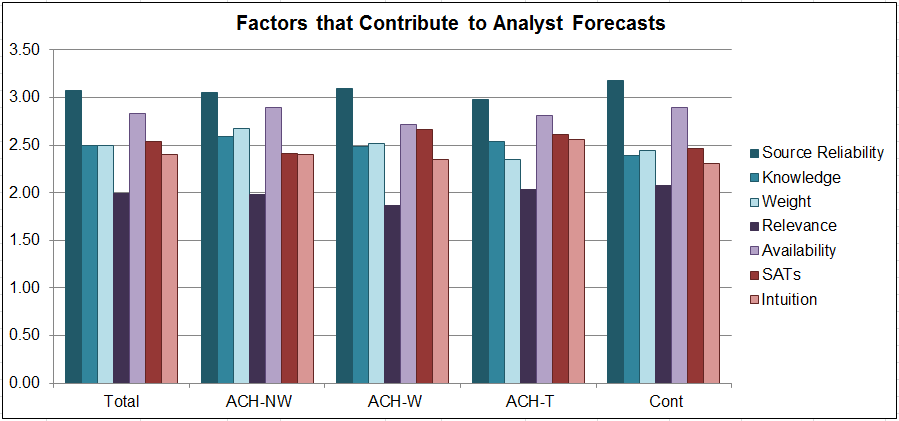
Figure 2. Self-Reported Survey Data of 115 Analysts Indicating Factors That Most Influence Their Analytic Process
Scale = 1 - 4

REFERENCES

Cheikes, B. A., Brown, M. J., Lehner, P. E., & Adelman, L. MITRE, Center for integrated intelligence systems. (2004). Confirmation bias in complex analyses (51MSR114-A4). Bedford, MA.

Jervis, R. (1989). Strategic intelligence and effective policy. In Frank Cass (Ed.), Intelligence and security perspectives for the 1990s. London, UK.

Nickerson, R. S. (1998). Confirmation bias: An ubiquitous phenomenon in many guises. Review of general psychology, 2(2), 175-220.

Pronin, E., Gilovich, & Ross, L. (2002). The bias blind spot: Perceptions of bias in the self versus others. Personality and social psychology bulletin, 28, 369-381.

Pronin, E., & Kugler, M. B. (2007). Valuing thoughts, ignoring behavior: The introspection illusion as a source of the bias blind spot. Journal of experimental social psychology, 43, 565-578.

Tolcott, M. A., Marvin, F. F., & Lehner, P. E. (1989). Expert decisionmaking in evolving situations. IEEE transactions on systems, man, and cybernetics, 19(3), 606-615.

Monday, March 17, 2014

What Do Intelligence Professionals Want From A Masters In Big Data?

http://www.flickr.com/photos/giladlotan/10601789774/
Currently, Mercyhurst University offers a Master of Science in Applied Intelligence. There is, however, a growing and persistent demand for intelligence professionals skilled in data science and "big data" analytics. 

But what should we include in that degree?  What courses?  What kinds of skills do intelligence focused companies, organizations and agencies want and need? 

To that end, we developed a survey to gauge the scope of organizations employing data science/analytics professionals, in addition to desired knowledge, skills, and abilities for professionals in this field.  

You can help us out by taking this short, 10 question survey now.  We will share the results here when available!


Thursday, March 6, 2014

An Intel-Dance(!) Joint Operation? You Betcha... (Entrepreneurial Intelligence)

No kidding.

This is a real thing.

http://kck.st/1gexKzM

When Mercyhurst Dance professor, Noelle Partusch, came to me in the fall to ask how the intel studies program could help her with a trip she and her dancers wanted to take to Jerusalem, little did I imagine that I would find myself smack in the middle of the Journey to Jerusalem Kickstarter Campaign.

Kickstarter is a highly popular (over a billion dollars collected so far...) crowdfunding platform.  People fund projects from art to books to games to, well, dance.  In fact, dance is one of the most statistically successful of the various Kickstarter categories with over a 70% success rate.

I have run two successful campaigns (For my games, Widget and CVTV) and so it made sense for Noelle to ask me for advice.  As I began to think about it, however, I saw a real opportunity to explore - in a more tangible way - some of my ideas about entrepreneurial intelligence and to give students a unique learning experience in the process.

Pretty soon I had a team of students working the details of the campaign.  If intelligence is, in some way, about the things that are critical to your success or failure but are fundamentally outside your control, then Kickstarter success or failure is all about intelligence.

I started with Emily Francis, one of our top undergrad intel students.  Emily is known for her intelligence, drive, and ability to work with others.  Kickstarter, with its focus on short (30 days is recommended) win-or-lose (you either meet your goal or you get nothing) campaigns, is a perfect place to start to hone leadership skills.  

I let Emily pick her own team and she quickly hired a copywriter, Alison Hosko, to help craft the marketing message and a social media manager, Amanda Marley, to help build an audience and get the word out.  We went to the Graphics Design Club here to get the logo.  Noelle, the other professors in the department, and the dancers themselves provided us with all the content and approved all the messages.  After building up an audience on Facebook, we launched on 18 Feb.

We are now a day past the midway point and, with the help of nearly 50 backers, over 100% funded.   Kickstarter allows projects to become overfunded, so we are going to try to push the dollar amount as high as we can knowing that every dollar the project makes goes to help the dancers.

Assuming we stay above our goal (dirty little secret:  In crowdfunding, people can cancel their pledges, too...), this is a big win for:
  • ...the dancers.  Every dollar will go to defray their costs.  
  • ...the backers - the people who pledged the dollars.  They not only get the excitement of helping these dancers achieve their dream, they also get tangible rewards, such as an exclusive video of the dancer's performance while in Jerusalem.
  • ...for the University (a double win to be exact).  
    • We have an excellent dance department here at Mercyhurst.  Efforts like this spread the word about that department and about the University in general in ways that traditional marketing can't match (for example, take a look at this article or this one...).  
    • In addition, our current University marketing campaign is built around the slogan, "Experienced Guaranteed." We do a lot of hands on, project based work in our classes here at Mercyhurst (particularly in the intel department).  This project makes that work interdisciplinary.
  • ...for the students, who not only get the experience of working on a project like this but also get a (modest) stipend for doing so.
  • ...for the community of Erie and rust-belt towns generally.  The rust belt has been the hub of heavy manufacturing in the US for so long that many places lack a body of what I call "pre-entrepreneurs" - people who could be entrepreneurs but haven't thought about it yet.  The environment for entrepreneurs is pretty good but there simply aren't enough people taking advantage of it because they don't think they can.  Project based crowdfunding sites, like Kickstarter, help overcome what is, in reality, a psychological problem.  
  • ...for entrepreneurial intelligence as a field of study.  Crowdfunding activities like this one provide a perfect laboratory for determining what entrepreneurs need from intelligence.  I have already learned a bunch of lessons and expect to learn more.
We have received good press so far (here and here) and almost 350 "likes" on Facebook.  It has all helped but if you like dance or are just interested in seeing how this project proceeds, drop the project a couple of bucks or share it with someone who will!

Tuesday, March 4, 2014

The Mind's Lie AKA "Biases With Friends" (Free Beta App)

BLUF:  The Mind's Lie is a free Android gaming app on the Google Play Store available now.  It is similar to games such as Words With Friends in that you are playing against real people and not against the machine.   

The game is designed to implicitly teach you and the other players (up to six players per game) to recognize confirmation bias, anchoring bias, stereotyping/representativeness bias, projection/mirror imaging bias, bias blind spot, or fundamental attribution error in more or less realistic situations. It is based off a successful tabletop game I designed.

Background:  A few years ago, I was inspired by IARPA's SIRIUS program (which seeks to develop a video game which will teach analysts to recognize and mitigate the effect of the six specific cognitive biases listed above) to try to come up with my own game that would do at least some of the same things.

I don't know how to design video games, though, so I did what I could do - design a tabletop game.  Called The Mind's Lie, it uses an argumentation mechanic to implicitly teach players how to recognize variants of the same six biases that IARPA is testing in the SIRIUS Project.  

Eventually, through some good fortune, I did get to be involved in SIRIUS as a part of a team that Boeing put together.  Mel Richey, who worked with me on that Boeing team, eventually tested The Mind's Lie using people from all over the US and showed that it seems to work - the more you play it, the better you get at identifying the presence of the six biases in more-or-less realistic scenarios.  


Since then, we have been using The Mind's Lie in a series of workshops and in class.  I have been encouraged by the fact that it seems to work best with people who understand that bias is a persistent risk in their day-to-day work - people like lawyers, soldiers and, yes, intelligence analysts.

At about the same time, I was asked to submit an idea for a senior project to the software engineers at Penn State (the Behrend Campus).  I have done this in the past and we had explored the possibilities of a balloon based surveillance system and a Bayesian calculator for analysts (among other ideas) together. 

What I wanted this time, though, was to turn The Mind's Lie into a Words With Friends-type game.  I wanted people to be able to re-create the experience of playing The Mind's Lie around a table while on the go.  The engineers, Steve Chalker, Joe Grise and Kit Torelli, along with their professor, Dr. Matt White, decided to turn my game into an android app.

Nearly a year later, the app is here.  It is not perfect - it's a beta version (at best), but it is out there and free to download and play.  Hope you like it!

Monday, March 3, 2014

What The Syrians Had To Say: Views from Istanbul (Part 5 Of A Multi-Part Series)

First of all, thank you to those who have stuck with us through this lengthy series on network analysis and Turkey. This will be the final installment, though the projects are still ongoing and the techniques still being refined and applied. 

Below are the stories from Syrians that have fled the country, collected by the author in January 2014. 

For those who missed the first four pieces, they can be found here: My Conversation With The Free Syrian Army, Ethnolinguistic Mapping, Gravity Model Analysis, and Population Simulations.

All the methodology involved in this lengthy project was recently presented at the International Network For Social Network Analysis Sunbelt Conference, and very well received (a big thanks to a very special CENTCOM Sunbelter who made the presentation and the trip to Turkey all possible). 

The methods led to very intriguing conclusions, some of which were confirmed and some of which were challenged by the Syrian refugee population in and around Istanbul, Turkey. In the suburbs of Istanbul, I spoke with many refugees to gain perspective on everything from their geographic movement to their political opinions, and what they had to say was equally as heartbreaking as it was informative. 

A woman held a one year, seven-month old child in her arms as she spoke to me in Arabic. "She is a living marker of the revolution," she told me. "She was just one month old when we left Syria; her life has only seen the war." 

Children playing outside for recess at a Syrian day school in Bayramtepe

A single mother of three, this woman had been living in an apartment in Fatih district of Istanbul since early 2013. The last time she had heard that her husband was alive after being incarcerated in Aleppo was March 2013. 

"We agreed before we left Syria," she said, "that if either one of us was killed or put in jail, the other one would continue to Istanbul." 

"Do you intend to stay in Istanbul?," I asked.

She replied that she could not leave. She hopes every day that her husband is alive, and if he is and escapes, he will only know to find her here. "I send money back to Aleppo for people to pay to the prison guards to ask about my husband. They take the money, but I never hear anything back." 

She was a woman of higher socioeconomic status, obvious from her black silk hijab. Many people living in Istanbul, namely the district of Fatih, are of a higher socioeconomic standing than those out in the suburbs, like Bayramtepe. 

Of all the people I interviewed, a total of 22 families and 152 individuals (about half of them children), there was a clear difference between groups of both lower and higher socioeconomic statuses. Those of the former group responded that they hoped to return to Syria as soon as possible. When asked what their ideal outcome would be, they replied that who would be in power in Syria did not matter, only that it was safe enough to return. 

Those of a higher socioeconomic status indicated that they did not intend to return to Syria. They were bitter and angry.

"Why would I go back?," one man shouted at me. "I have lost everything! There is nothing there for me and my family!"

"What would you like to see happen in Syria, politically," I pressed, despite his challenging tone. 

"Assad has treated the Syrian people like animals," he replied. He spoke of the need for international intervention. He expressed his disbelief at the U.S. government's lack of initiative in the region. "And this Geneva conference..." he continued, "they are just playing their game." He spit these last words at me before taking a sip of the Turkish tea his son's wife had made for us on arrival. 

This interaction was representative of the class divide among those with whom I spoke. 

The following day I walked through Bayramtepe, sun setting quickly around 1600 behind rolling hills littered with cinder blocks and the occasional haggard donkey. Crawling out of the muddy streets and up the cement stairs to a shack on stilts, I was overwhelmed with the smell of garlic and cooked greens as the door opened. A chorus of Salaam Alaikum filled the entryway as I pried my muddy boots off my feet for about the 20th time that day.

It was a single room with a drafty roof, but it was cozy, with a pot in the center that contained simmering green leaves. Many children, too many to count, ran in and out of the house as a woman, upwards of 95, tottered around yelling at them to keep quiet for the guests. She brought out an apple on a tray for the seven of us to share.

"We walked," she told me, "first from Damascus, then to Raqqa where we crossed the Turkish border at Tel-Abyad." 

"What was the most difficult part of your trip?," I asked. 

She mentioned walking all that way with all the children (more than 10) and her mother, who was ill (the 95-year old woman who was surprisingly lively and cheerful, excited to have company). 

"Also," she pressed on after she had contained her tears enough to continue, "when we crossed the border, the Turkish police caught us on the other side. None of us had passports, so they returned us back to Syria. We had to wait for them to leave before sneaking across the border the following night."

This was a common story I heard from the refugees. Almost none had passports or citizenship papers. Many were captured and returned to Syria, but then sneaked over the border later. 

"My life was saved by an American," a man later told me.

This was intriguing.

"I was captured near Aleppo by the Syrian government, and put in jail with my family. We stayed there for a few days until another man was put in jail with us. An American, I think. He spoke only in English. Later that day, I heard the military talking and the captured man was someone of great importance, so the Syrians took us all, my family and the man, and left us out in the middle of the country near Aleppo. They just drove away. I was lucky."

Thoughts of who this man might have been flashed through my mind. A journalist, perhaps? An international peacekeeper? Someone the Syrians did not want to be responsible for incarcerating. 
Bayramtepe, Turkey


The refugees were from Aleppo, Raqqa, Homs, Idlib and Damascus. They had come to Istanbul looking for work, some by way of Cairo. It was encouraging to hear that those that had crossed the border between Syria and Turkey had all crossed at the precise locations used in my simulations. 

I also learned that most traveled on foot through Syria and then by bus from Turkish border towns to Istanbul. The factors in my simulation reflected railways and roadways. In retrospect, railways were unnecessary, where roadways were important, but so pervasive throughout such a developed country that the factor hardly would have made a difference. It is through these valuable insights that I can now alter the factors in the simulation to better represent the region hosting the population and the characteristics of the population itself. 

A final surprise from Istanbul was the groups of people that I encountered. I expected to find Shia Kurds, Christians and Alawites, all minorities in the Sunni Muslim refugee camps near the border. What I found were both Sunni and Alevi (Shia) Kurds, some Sunni Muslims and no Christians. Where were the Christians?

Granted, I had assumed they would be in Istanbul by process of elimination. They did not go to Jordan, Lebanon or Iraq, but preferred Turkey's more secular environment. They were not in the refugee camps near the border, though, so I assumed they must be among those migrating to Istanbul. After speaking with those who knew the entire Syrian population in Istanbul and its suburbs I determined there were no Christians in the area. Where were the Christians? News articles answered the question for me once I got home.

In speaking with a man named Azzad, the leader of a private Syrian refugee organization in Bayramtepe that survives on donations from Turkish citizens, he indicated that he had registered 2,500 families, upwards of 12,000 people, with 5 - 10 new families arriving daily. He said that no one leaves and everyone needs help. The majority of the refugees are Kurds.

A man named Muffa who runs the same kind of organization in Fatih district of Istanbul indicated he had 5,500 families in the city with 100 new families registering every month. 

"If I had to guess," he told me, "about 20 percent of the people in Fatih are Kurdish." 

These are just some of the many stories from the refugees that I spoke with representing the ways in which they challenged and confirmed my analytic predictions. 

While I continue to follow the crisis in Syria, my current research involves the application of the methods presented in this multi-part series to central Africa. The utility of the methodology developed is its flexibility, but different regions and refugee groups require a comprehensive re-evaluation of the factors influencing the simulation. 

With luck, look for the information on Central Africa to surface sometime early summer!